
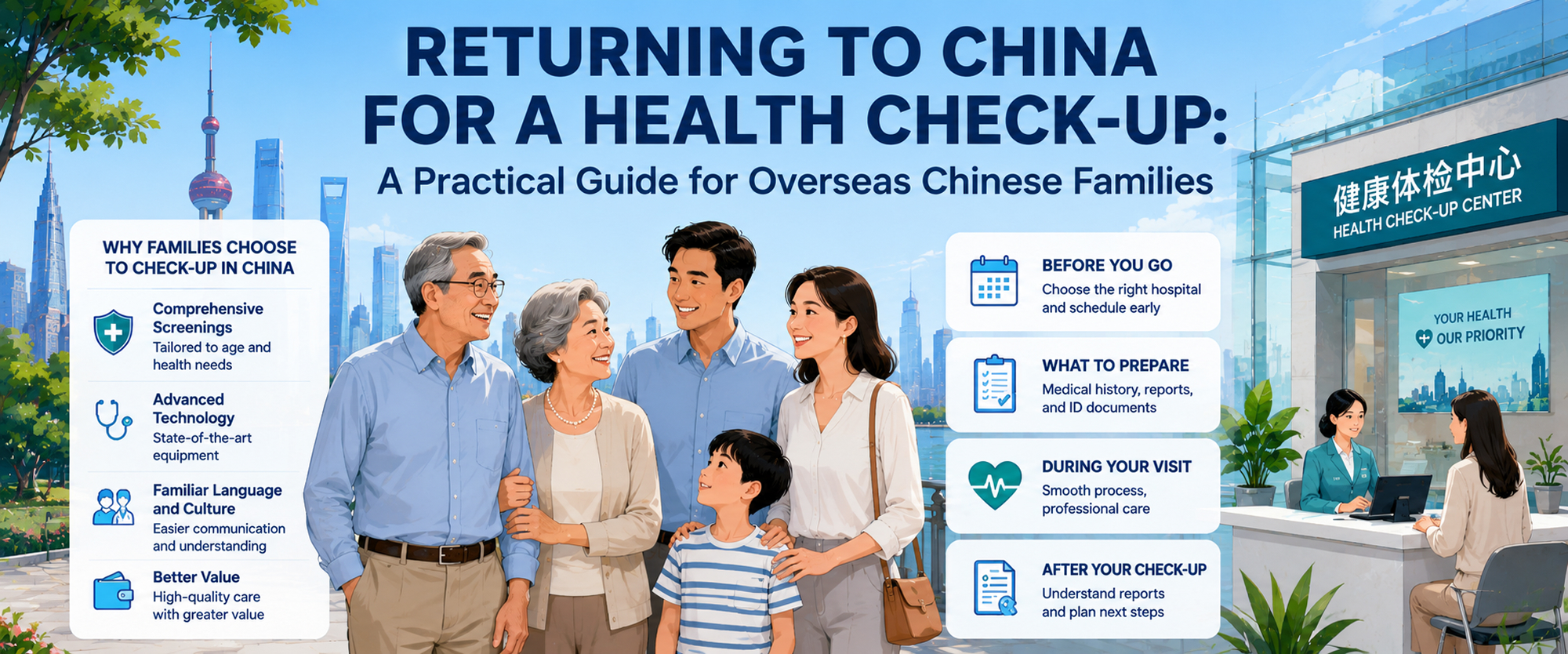
For many overseas Chinese families, a return trip to China creates a rare window for health screening. The calendar may already be full—family visits, errands, business meetings, school holidays, and travel between cities—but a check-up can still work if the medical plan starts before the trip begins.
China’s health check-up system can feel very different from screening abroad. In many countries, blood tests, imaging, digestive screening, and specialist review may sit across separate clinics, referral routes, and timelines. In China, many hospital-based health examination centers organize routine screening as a dedicated visit. Registration, fasting tests, ultrasound, ECG, selected imaging, physical examination, and report review can often sit inside one planned route.
The tests themselves are familiar across countries. The China-specific part lies in how they are packaged, scheduled, documented, and returned to the patient.
Start With the Trip, Then Choose the Package
A highly effective planning approach starts by looking at the calendar before looking at the medical packages. First, determine how many usable medical slots the family actually has in one city, and identify what fits inside them.
| Time in one city | What often works in China | What needs more room |
|---|---|---|
| One free morning | Basic screening: blood work, urine testing, blood pressure, ECG, selected ultrasound, basic physical examination | Full report discussion, specialist review, advanced imaging with later reporting |
| One full day | Broader package plus selected add-ons inside the same check-up route | Digestive endoscopy, pathology-related items, follow-up visits |
| Two to three days | Screening first, then report pickup or explanation | Sedated endoscopy, complex imaging, items with later reports |
| Five to seven days | Screening, report collection, physician explanation, and one focused follow-up question | Multi-step cases requiring several departments |
| Two medical slots | Check-up early in the stay, then report review or one targeted consultation | Broad “review everything” requests |
A late-night arrival can make fasting tests harder the next morning. A trip split across several cities can make report pickup harder. For elderly parents, a slower schedule usually works better than a tightly packed morning.
During Spring Festival, Golden Week, summer school holidays, and other peak travel periods, ask about appointment availability several weeks before arrival. Morning fasting slots usually fill first.
For readers still comparing elective health screening with other examination routes in China, see Health Check-ups in China: A Complete Guide for International Visitors.
How Check-up Packages Work in China
Package names vary between facilities and carry no standardized national definition. The specific test list matters far more than the package label. The sections below describe what each screening type typically includes in China and highlight how the access model differs meaningfully from overseas systems.
For a broader overview of check-up types and how they compare across facility categories, see Health Check-ups in China: A Complete Guide for International Visitors.
Basic screening in a health examination center
A basic check-up gives a current health baseline. It commonly includes:
- height, weight, waist measurement, blood pressure, and pulse
- blood and urine testing
- liver and kidney function
- blood lipids, glucose, uric acid, and related metabolic markers
- ECG
- abdominal ultrasound or other selected ultrasound items
- chest imaging or other basic imaging, depending on the package
In many overseas systems, similar checks may involve a family doctor visit, a separate lab visit, imaging at another facility, and later review. In China, many health examination centers place these routine items inside one morning route and issue a collected report.
That format suits return-trip screening. It gives families a baseline file for later comparison in China or overseas.
Cardiovascular and metabolic add-ons
For adults over 40, individuals with hypertension, diabetes, or elevated cholesterol, or anyone with a strong family history of cardiac events, cardiovascular add-ons attach directly to a basic package. Common additions include carotid ultrasound to assess arterial wall thickness and plaque, echocardiography to evaluate heart function, and coronary CT angiography for higher-risk individuals. Blood tests may extend to homocysteine and high-sensitivity CRP alongside the standard lipid panel.
In many countries, accessing this specific range of cardiovascular tests requires a GP referral followed by a specialist waiting list. In China, individuals can request these as self-directed add-ons at the time of booking without any prior referral.
Digestive screening and endoscopy
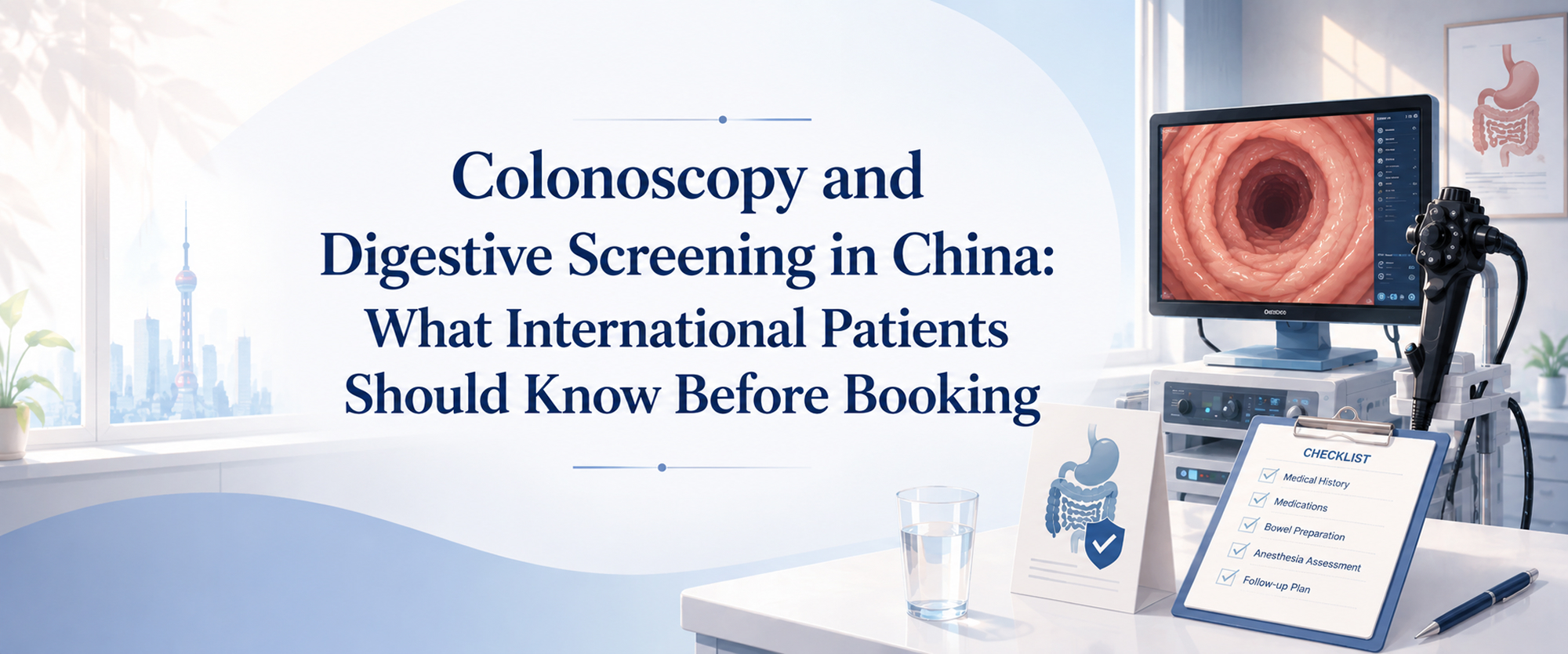
Gastroscopy examines the esophagus, stomach, and upper small intestine. Colonoscopy examines the colon and rectum. At most major hospital-based centers in China, both procedures offer a sedation option using propofol, referred to locally as “painless” (无痛) endoscopy. Facilities typically arrange endoscopy as a separate procedural service rather than part of the standard check-up station flow, complete with its own preparation requirements and recovery period.
In the UK, Australia, Canada, and most other countries, securing a colonoscopy begins with a GP referral and a specialist waiting list that spans several months. In China, the exact same procedure remains bookable directly as a preventive screening measure.
This requires dedicated planning. Colonoscopy requires strict bowel preparation the evening before. Sedation requires a recovery period and prohibits driving the same day. Allocate a completely separate calendar day for endoscopy.
A 14C Helicobacter pylori breath test provides a less invasive alternative for checking H. pylori without a scope, and facilities commonly include it in standard packages or offer it alongside endoscopy services.
Imaging and specialty add-ons
In Western clinical practice, doctors generally order these markers in response to active symptoms or confirmed diagnoses rather than as routine preventive screening. For many overseas Chinese, a return trip offers a rare opportunity for proactive access.
China’s package-based screening can make add-ons easy to select. Ultrasound, CT, MRI, low-dose chest CT, bone density testing, and specialty blood items may appear on the same menu or booking page.
Use a clear filter before adding imaging:
- What clinical question does this test answer?
- Does it require contrast?
- Does it need a separate appointment time?
- When will the written report come out?
- Can the patient collect the original image files?
- Will an overseas doctor need the images later?
The written imaging report and the image files serve different purposes. The report gives the radiologist’s reading. The original image files allow another doctor to review the scan directly. For CT, MRI, and X-ray, ask whether the facility can provide files in a standard digital format.
Facility type also affects language support, report explanation, insurance handling, and follow-up access. For a comparison of public hospital health examination centers, international departments, and private facilities, see Health Check-ups in China: Comparing Public vs. Private Options.
Preparing a Useful Medical File
A short, readable file helps the China-side reviewer understand the person quickly. It also helps families avoid booking the same package for everyone.
A one-page summary works far better than a disorganized folder of mixed papers.
| Information | What to include |
|---|---|
| Current medications | Name, dose, frequency, and reason for use |
| Allergies | Medication, food, contrast agent, latex, or other known reactions |
| Major diagnoses | Hypertension, diabetes, thyroid disease, heart disease, cancer history, kidney disease, liver disease, autoimmune disease |
| Surgery history | Procedure name, year, body part, major implants if relevant |
| Family history | Heart disease, stroke, diabetes, colorectal cancer, breast cancer, stomach cancer, liver disease, or other relevant conditions |
| Recent symptoms | Start date, pattern, triggers, and current status |
| Recent test results | Blood work, imaging reports, pathology reports, specialist letters |
Records worth bringing
Bring prior records when they may affect the screening plan:
- recent blood work
- prior health check-up reports
- ultrasound, CT, MRI, X-ray, or endoscopy reports
- original imaging files when available
- pathology reports
- surgery or discharge summaries
- current medication list
- insurance documents when reimbursement may apply
The file should give the reviewer the details that affect interpretation. For imaging, bring both the written report and the original image files when available.
For a closer look at record types and imaging formats, see Medical Records & Imaging in China: A Guide for International Patients.
Questions to Confirm Before Booking
Booking questions for a return-trip check-up should focus entirely on how the visit is structured, rather than only discussing the price or package name. The goal is to understand the visit as a coordinated service flow before committing to a date.
Confirm these details before finalizing the appointment:
- Does the package run strictly through a dedicated health examination center? This clarifies whether all items stay inside the same check-up flow or if some require separate department bookings across the hospital campus.
- For endoscopy: is it handled as a separate procedural service? Ensure the facility provides clear preparation instructions and an assigned recovery bed.
- When should fasting begin? Blood work and abdominal ultrasound set the pace for the entire morning.
- Will the report include a chief physician’s reviewed conclusion? This consolidates all individual findings into one actionable summary.
- Which parts of the report are ready the same day? Identify which items—such as radiology reads or pathology from biopsies—require additional working days.
- Can the facility provide digital copies, stamped paper reports, original image files, and formal billing documents? Overseas doctors and international insurers require specific formats.
- If a result needs follow-up, can the next step happen within the same hospital system? A short trip demands a clear route for result explanation or specialist review.
Chinese nationals living overseas should confirm which identity document the facility wants to use for registration. People with foreign passports usually register with the passport used for booking.
How Chinese Check-up Reports Work
A Chinese health check-up report usually contains two layers.
The first layer contains individual result pages: blood work, urine testing, ECG, ultrasound, imaging reports, and other examination findings. These pages show the raw results.
The second layer is the reviewed conclusion, often called the chief physician’s conclusion in health examination settings. A reviewing physician reads the separate findings together, removes repeated observations, ranks the main issues, and gives follow-up guidance.
Start with the reviewed conclusion. It tells the family which findings belong in long-term tracking, which ones need repeat testing, and which ones deserve clinical review.
| Finding type | What it usually means | Practical next step |
|---|---|---|
| Track | A value or finding to compare over time | Keep the report for future reference |
| Recheck | A borderline or context-sensitive result | Ask when and where to repeat the test |
| Clinical review | A finding that calls for doctor assessment | Ask which specialty should review it |
| Earlier review | A finding with a shorter follow-up window | Ask whether same-trip outpatient review can happen |
Screening can raise a clinical question quickly. Diagnosis still requires a doctor’s evaluation, sometimes with further testing.
For a closer look at chief physician conclusions, follow-up wording, and how to sort flagged findings, see Health Check-up Results in China: Reading Your Report and Using It.
Documents to Collect Before Leaving China
A return-trip check-up report needs to travel. It may go to an overseas doctor, an insurer, an employer record, or a family medical file. Collect the documents before leaving the facility whenever possible.
| Document | Why it matters |
|---|---|
| Complete health check-up report | Main record of the screening |
| Reviewed conclusion or physician summary | Best starting point for another doctor |
| English report, English summary, or medical translation | Helps overseas doctors and insurers read the key findings |
| Stamped paper report | Useful for formal records, insurance, or employer files |
| Electronic report | Useful for backup and quick sharing |
| Written imaging reports | Gives the radiologist’s reading |
| Original imaging files | Allows another doctor to review the scan directly |
| Fāpiào / official invoice | Formal proof of payment in China |
| Itemized expense list | Shows what each charge covered |
Ask about electronic reports and image files early. Some facilities show written results in an app or WeChat mini program, while image files may require a separate request at a counter, self-service machine, radiology department, disc window, or download channel.
The fāpiào is China’s official invoice. A payment screenshot or cashier slip may help with personal tracking, but insurers often need the fāpiào plus an itemized expense list. Keep medical papers and billing papers together.
When Same-Trip Follow-up Makes Sense
A same-trip follow-up visit can help when the report raises one clear question and enough time remains in the city.
It may make sense when the report includes:
- a reviewed conclusion recommending specialist evaluation
- a new imaging finding that needs explanation
- abnormal blood results linked to an existing condition
- symptoms that match the screening finding
- a prior abnormal result that needs comparison
- planned endoscopy, imaging, or follow-up testing
For a short return trip, a focused question works best. “Please review this thyroid ultrasound finding” gives the doctor a clearer starting point than “Please review everything.”
If the report comes out close to departure, ask whether outpatient review can happen within the same hospital system before leaving China. When same-trip review cannot happen, leave with the full report set, image files, and billing documents in order, then arrange clinical review overseas promptly.
GET IN TOUCH
Planning a Health Check-up During Your Return Trip?
A return-trip check-up works best when the family sorts out three things before booking: the schedule, the prior records, and the documents that need to travel back overseas. This becomes especially important when several family members, chronic conditions, digestive screening, advanced imaging, or follow-up questions enter the plan.
FAQ
Q1. Why do many overseas Chinese families arrange health check-ups during a return trip?
China often offers a more concentrated health examination route. Many routine screening items can sit inside one planned visit, and the family can collect a formal report package before leaving. This works well for people who have delayed screening abroad or want to coordinate check-ups for several family members.
Q2. How far in advance should families book a return-trip check-up?
Secure bookings four to six weeks before arrival during Spring Festival, Golden Week, and summer school holidays. Outside those peak periods, two to three weeks provides sufficient lead time at most major health examination centers. Popular early morning fasting slots consistently fill faster than afternoon appointments.
Q3. What feels most different about a health check-up in China compared to overseas?
The centralized structure stands out the most. At hospital-based health examination centers, blood work, imaging, ECG, and physical examinations run through one coordinated visit flow. A chief physician reads all the results together and issues a consolidated conclusion. Overseas, reaching the equivalent baseline typically involves separate GP referrals, separate facility bookings, and no single physician reviewing the full picture at once.
Q4. Can gastroscopy or colonoscopy fit into a return trip?
Yes, but always plan it as a separate medical slot, not a same-morning add-on to a basic check-up. Colonoscopy requires strict bowel preparation the evening before. Sedation requires a recovery period and prohibits driving the same day. A check-up morning and an endoscopy day function best on entirely different calendar days.
Q5. Should prior reports from abroad be translated before bringing them?
No translation is needed before arriving. English-language reports and imaging files are readable at most major health examination centers. Bring them and present them at registration so the reviewing physician can account for prior baseline findings when interpreting new results.
Q6. What does the chief physician’s conclusion page actually do?
It consolidates the results from all test stations into one reviewed assessment, written by a senior physician who has evaluated the complete data set. It removes duplicate flags across departments, organizes findings by clinical priority, and states exactly what each result requires—ongoing tracking, a repeat test, or specialist review. That single page is the most important document to hand to an overseas doctor.
Q7. What specific documents should families collect before flying home?
Collect the full signed report with the official hospital stamp, the chief physician’s conclusion, written imaging reports, original image files in DICOM format, a digital backup, the fāpiào (official tax invoice), and the itemized expense list. Request image file access at registration, as some centers need advance notice to prepare a disc or download link.
Q8. Can the same trip include both a check-up and a follow-up specialist visit?
Yes, when the medical finding is specific and the trip still has available days. Same-system referrals from health examination centers to outpatient specialist departments function highly efficiently at major facilities. A focused specialist question about one specific result works perfectly in this setup.