
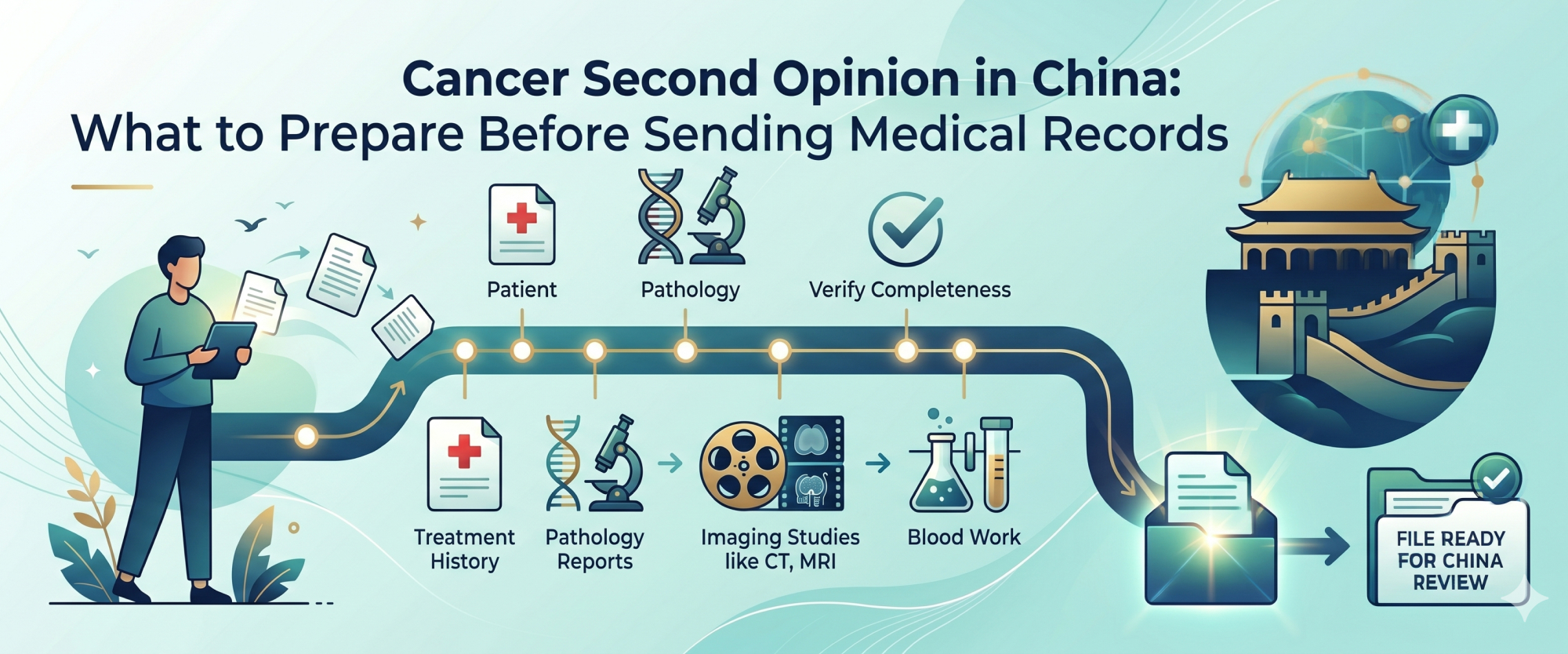
Before an overseas patient decides whether to travel to China for cancer care, a cancer second opinion can offer a lower-commitment first step. The review begins with records rather than a hospital visit. A doctor needs enough material to understand the diagnosis, stage, previous treatment, current condition, and the question the patient wants answered.
For oncology, the record set often includes pathology reports and, when available, pathology slides; written imaging reports and original image files; gene testing or biomarker reports; surgery notes; chemotherapy, radiotherapy, targeted therapy, or immunotherapy records; current medicines; and a clear timeline. These materials let the reviewer see the case as a whole rather than as disconnected reports.
This article explains how to prepare that file before sending it for review in China. It also explains how MDT, pathology review, and imaging review differ, and how a second opinion can support medical understanding while the treating doctor continues to guide care through examination, updated tests, and direct clinical assessment.
What a Cancer Second Opinion Can Clarify
A cancer second opinion helps another doctor read the case from the available evidence. It may clarify how the diagnosis, stage, pathology findings, imaging results, gene testing, and treatment history fit together. It can also turn a broad concern into a sharper question for the next consultation.
Patients often request a second opinion after a new diagnosis, before a major treatment decision, after a proposed treatment change, or when new scans raise a recurrence concern. Some cases involve several moving parts: biopsy pathology, surgery records, CT or MRI images, gene testing, chemotherapy cycles, radiotherapy plans, targeted therapy, or immunotherapy.
A record-based review supports medical understanding and treatment discussion. Care decisions still require the treating doctor’s evaluation, the patient’s current condition, physical examination, and updated tests when the case calls for them.
China’s health authorities have promoted tumor diagnosis and treatment quality through clinical guidelines, clinical pathways, anti-cancer drug management, and multidisciplinary diagnosis and treatment. The National Health Commission has also promoted tumor MDT work as part of cancer care quality improvement.
Start With the Medical Question
A useful second-opinion file starts with a question. A large folder with many reports can still feel hard to read when the doctor has to guess the decision point. A better file tells the reviewer what the patient wants to clarify.
A diagnosis question may read:
Does the existing pathology and imaging support the recorded cancer type and stage?
A treatment question may read:
Do the pathology, imaging, gene testing, and treatment history support the proposed next treatment step?
A recurrence question may read:
Do the new scan findings suggest recurrence, treatment response, or a change that needs further evaluation?
Place the question at the front of the file, followed by a one-page case summary. That page should include the patient’s name as shown in hospital records, age, diagnosis, diagnosis date, current treatment status, main symptoms, current medicines, and the reason for review.
Keep the summary factual. Dates, body sites, treatment names, scan findings, and medication names help more than a long personal narrative. Mark uncertain details as “to confirm” and attach the source document.
Current Condition and Treatment Timeline
The current patient picture belongs near the front of the file. Older records explain the original diagnosis. Current symptoms, medicines, and daily function show what the doctor needs to assess now.
Write a short current-condition note in plain language. Include the main symptoms, such as pain, cough, bleeding, fever, fatigue, appetite loss, bowel changes, swelling, dizziness, or weakness. Add daily function: walking, eating, sleep, self-care, stairs, work, and time spent in bed. This gives the reviewer a sense of physical condition before they read long reports.
List current medicines in one place. Include cancer drugs, pain medicines, steroids, anticoagulants, antibiotics, diabetes medicines, heart medicines, and supplements. For oral targeted drugs or home medicines, write the start date, dose, pauses, side effects, and current use. When the record only shows a brand name, keep the original name and add a prescription photo or copy.
Then build a simple timeline:
- January 15, 2026: first CT found a lung mass
- January 22, 2026: biopsy completed
- February 10, 2026: first drug treatment cycle started
- April 20, 2026: follow-up CT completed after treatment
- May 5, 2026: second-opinion question prepared
Each timeline entry should match a document in the folder. If the timeline says surgery took place on March 10, the file should include the operative note, discharge summary, and final pathology report. If the timeline says radiotherapy ended on April 25, the file should include the treated site, dose, fraction schedule, and treatment summary when available.
Pathology Reports and Slides
Pathology often anchors an oncology file. The pathology report — 病理报告 (bìnglǐ bàogào) — may show tumor type, grade, margin status, lymph node findings, immunohistochemistry, and other tissue-based findings. For many cancers, treatment discussion starts from this information.
A written pathology report gives the original conclusion. A pathology slide — 病理切片 (bìnglǐ qiēpiàn) — lets a pathologist review the tissue directly when slide review matters. Some cases may also involve unstained slides, a paraffin block, immunohistochemistry pages, or a molecular pathology addendum.
When preparing pathology materials, collect the biopsy or surgery pathology report, immunohistochemistry report, molecular pathology or biomarker addendum, and final surgical pathology report when the patient had tumor removal. If the review needs slide material, ask the original pathology department what it can provide and what request process it uses.
China’s medical record rules include pathology reports, laboratory reports, special examination records, surgical records, discharge records, and medical imaging materials among records that applicants can copy or access. These rules also describe how patients and authorized agents apply with identity and authorization materials.
Match every pathology document to the correct procedure date. A patient may have an initial biopsy, surgical pathology, and a later biopsy after recurrence. Clear labels help the reviewer know which tissue sample each report describes.
Imaging Reports and Original Image Files
Imaging review often needs more than the written report. The written report gives the radiologist’s interpretation. The original image files let another doctor or radiologist review the scan directly, compare lesions, measure change, and assess staging, treatment response, or recurrence concerns.
For CT, MRI, PET-CT, ultrasound, X-ray, endoscopy images, or nuclear medicine studies, collect both the written report and the original image files. Many doctors use DICOM files for direct image review. The file may come on a disc, USB drive, hospital export, or digital link, depending on the medical institution’s system.
Label every scan by date and body site. “April 12, 2026 — CT chest/abdomen/pelvis” works better than “CT report.” For treatment response, include the baseline scan before treatment and the follow-up scans after treatment. A single scan may show the current state, while a comparison set shows direction.
National electronic medical record rules define electronic records as digital medical information that can include text, symbols, graphics, numbers, images, and other content generated during clinical care. These rules also require medical institutions to provide electronic medical record copy services to applicants, and qualified institutions may provide copies of imaging examination images and other electronic materials.
Gene Testing and Biomarker Reports
Gene testing reports can affect discussion around targeted therapy, immunotherapy, treatment resistance, recurrence, and clinical trial screening. Their value depends on cancer type, sample source, test method, report date, and current treatment question.
Send the full report rather than only the conclusion page. The reviewing doctor will usually want to see the sample source, collection date, test method, genes or markers covered, main findings, report limitations, and any treatment already linked to the result.
A tissue-based report and a blood-based report may answer different questions. A report from the time of diagnosis may also differ from a report after progression or recurrence. For that reason, the date and sample source matter. If a drug decision followed the report, add the prescription record or treatment note that shows how the result entered care.
Some reports include drug interpretation pages. Treat those pages as supporting information. The reviewing doctor still needs pathology, imaging, stage, treatment history, current condition, and current medicines before discussing next steps.
China’s tumor quality improvement plan asks medical institutions to follow diagnosis and treatment guidelines, technical standards, and clinical pathways, and to consider tumor pathology type, stage, grade, molecular features, and patient condition in tumor care.
Surgery, Drug Therapy, and Radiotherapy Records
Previous treatment records show what the patient has already received and how the disease responded. A reviewer needs this context to understand the current question.
| Treatment type | Records to prepare |
|---|---|
| Surgery | Operative note, discharge summary, final pathology, margin status, lymph node findings, postoperative complications |
| Chemotherapy | Drug names, cycle dates, number of cycles, dose changes, side effects, response assessment |
| Radiotherapy | Treated body site, total dose, fraction plan, start date, end date, treatment summary when available |
| Targeted therapy | Drug name, start date, gene or biomarker basis, response, resistance findings, stopping reason |
| Immunotherapy | Drug name, cycle dates, response imaging, immune-related side effects, steroid use when relevant |
| Supportive treatment | Pain medicines, anticoagulants, nutrition support, bone-strengthening drugs, transfusions, infection treatment |
Surgery records show what the surgical team did and what postoperative pathology found. Drug therapy records show the treatment sequence, response, side effects, and stopping reasons. Radiotherapy records deserve special attention because the treated body site, total dose, and fraction schedule shape later treatment discussion.
Keep treatment records close to the timeline. A reviewer should be able to move from “cycle 1 started” to the drug record, from “radiotherapy ended” to the radiotherapy summary, and from “follow-up scan completed” to the matching imaging files.
MDT, Pathology Review, and Imaging Review
MDT, pathology review, and imaging review answer different questions. They can appear in the same second-opinion process, but each one reads a different part of the case.
| Review type | Who usually participates | Main focus |
|---|---|---|
| Pathology review | Pathologist | Tissue diagnosis, tumor type, grade, margins, immunohistochemistry, biomarker context |
| Imaging review | Radiologist or relevant specialist | Original scan findings, staging, treatment response, recurrence, comparison over time |
| MDT discussion | Doctors from more than one specialty | Treatment direction across surgery, medical oncology, radiotherapy, imaging, pathology, and supportive care |
Pathology review may help when the diagnosis depends heavily on biopsy or surgical tissue, or when tumor type, grade, margins, or immunohistochemistry affect treatment discussion. Imaging review may help when staging, recurrence, metastasis, surgical planning, radiotherapy planning, or treatment response needs direct image comparison.
MDT discussion may help when the case involves several treatment paths, such as surgery, drug therapy, radiotherapy, and follow-up. It can also help when several specialties need to read the same file from different angles.
China has an official policy context for tumor MDT work. The National Health Commission has described tumor MDT formats such as outpatient MDT, inpatient MDT, and remote MDT, with work systems, standardized processes, quality control, and hospital-level oversight.
When Someone Else Organizes the File
Many cancer files reach a second-opinion doctor through someone other than the patient. A family member may gather records, translate document names, request image files, or send the final folder. This role helps most when it keeps the medical record accurate and complete.
Start with consent. Keep the patient’s authorization ready when requesting copies, pathology materials, imaging files, or inpatient records. Use the same patient name, passport name, or legal name that appears in the hospital record. A name mismatch can slow record retrieval or make files harder to match.
Keep originals and summaries separate. A translated summary can help a reviewer move through the file, but the original report remains the source document. Send full reports and DICOM files when available rather than only screenshots.
A simple folder structure can make the file easier to read:
- 01 Case summary and current question
- 02 Pathology
- 03 Imaging reports and DICOM files
- 04 Gene testing and biomarker reports
- 05 Treatment records
- 06 Current medicines and recent labs
- 07 Authorization and administrative documents
When a detail remains uncertain, write “to confirm” and attach the source document. For example, if a chemotherapy drug name appears unclear, include the prescription page and ask the reviewer or treating team to confirm it.
Sending Records for Review
Before sending records, organize them by date and type. Clear file names help the doctor read the case without opening every document first.
2026-01-22_pathology_report_biopsy.pdf
2026-02-10_chemotherapy_cycle_1_record.pdf
2026-04-20_CT_chest_abdomen_report.pdf
2026-04-20_CT_chest_abdomen_DICOM.zip
2026-05-05_current_condition_summary.pdf
Read the timeline from top to bottom before sending the folder. Each event should have a matching document. The diagnosis should match the pathology report. The stage should match the imaging and clinical notes. The treatment history should match surgery records, drug records, radiotherapy records, or discharge summaries. The current question should match the newest symptoms, scan, lab result, or treatment decision.
A complete file gives the reviewing doctor more context. When key materials remain unavailable, the doctor may still read the available record set and explain which questions require more documents or updated evaluation.
GET IN TOUCH
Get a Remote Second Opinion Before Your Next Medical Decision
- Get a records-based written or video Remote Second Opinion from specialists in China.
- Better understand your existing diagnosis, test results, and treatment recommendation.
- Clarify whether to continue local care, prepare additional records, or seek further specialist evaluation.
- If in-person evaluation is recommended, explore possible care coordination options in China.
- If you already have pathology, imaging, gene testing, or treatment records, a structured file can make the first review more focused. Prepare the key records, current-condition summary, and timeline before asking a doctor to assess the case.
FAQ
Q1. What records should I prepare for a cancer second opinion in China?
Prepare the pathology report, pathology slides when available, imaging reports, original imaging files, gene testing reports, surgery records, chemotherapy records, radiotherapy records, targeted therapy records, immunotherapy records, discharge summaries, recent lab results, current medicines, and a treatment timeline.
Q2. Do I need pathology slides, or is the pathology report enough?
The pathology report gives the original diagnosis and key findings. Pathology slides allow another pathologist to review the tissue directly when slide review matters. Ask the original pathology department what materials it can provide, what authorization it requires, and whether it can prepare unstained slides or release selected materials for outside review.
Q3. Do doctors need original CT or MRI files for imaging review?
Original image files help the reviewer look beyond the written report. CT, MRI, PET-CT, or other DICOM files can support direct review of tumor location, lesion size, lymph nodes, metastasis, recurrence, and treatment response. The written report and original image files should travel together.
Q4. What is the difference between MDT and a second opinion from one doctor?
A single-doctor second opinion gives one specialist’s review. MDT brings more than one specialty into the discussion, such as surgery, medical oncology, radiotherapy, pathology, imaging, and supportive care. MDT may help when the case involves several possible treatment paths or when diagnosis, stage, and treatment direction all need joint review.
Q5. When does pathology review matter most?
Pathology review may matter when the diagnosis depends on biopsy or surgical tissue, when tumor type or grade affects treatment, when immunohistochemistry or biomarkers need confirmation, or when the planned treatment depends heavily on the original pathology conclusion.
Q6. When does imaging review matter most?
Imaging review may matter when staging, recurrence, metastasis, surgical planning, radiotherapy planning, or treatment response remains unclear. It also helps when several scans need comparison across time. Send both the written report and the original image files for each relevant scan date.
Q7. Can a family member organize and send cancer records?
Yes. A family member can help when the patient gives consent and the receiving doctor or institution accepts the authorization route. For hospital record copying in China, patients or authorized agents usually need identity documents and authorization materials. Confirm the exact requirements with the original medical institution before collecting records.
Q8. How does a cancer second opinion support final treatment planning?
A cancer second opinion can clarify diagnosis, staging, treatment history, missing documents, and questions for the next consultation. Final treatment planning depends on the treating doctor’s clinical evaluation, current condition, physical examination, updated tests when needed, and the patient’s preferences and medical fitness.