
China’s hospitals can be highly efficient once you understand the process.
Over the last decade, many hospitals in China have gone digital: booking, payment, test orders, and results are are typically managed via hospital apps or WeChat mini programs. That speed is a real advantage, but the first visit can feel confusing if you don’t know the steps.
This guide walks you through what a typical doctor visit looks like in China, what most often slows foreigners down, and how to avoid the most common time-wasters.
Here is what to expect:
- China is strongly department-based, so choosing the right department is one of the simplest ways to save time.
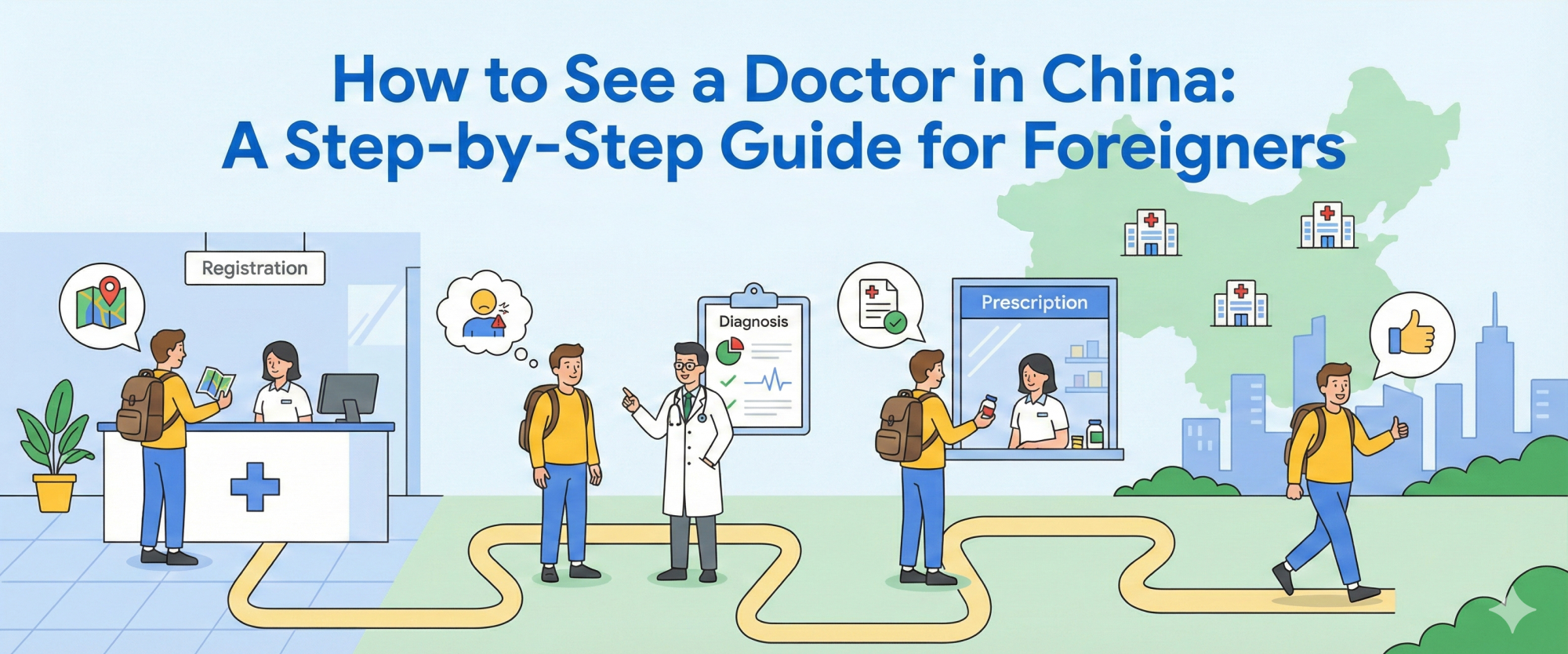
- A typical visit flow: Registration → Consultation → Payment → Tests (if needed) → Results → Diagnosis & Prescription → Payment → Pharmacy/Treatment.
- Common sticking points: booking with a passport, language barriers, payment methods (mobile payment vs. cards), and collecting the right documents for insurance.
Before you go: choose the right place and the right department
Where to go
If you want the most comprehensive care, you will usually end up at a public hospital (often a tertiary, Level III hospital). If you want stronger language support and a smoother process, consider a public hospital’s International Medical Department (IMD) or a private international hospital. For a clear explanation of these options, see Understanding China’s Healthcare System.
Choose the right department
In China, you usually need to choose a department when you book. If you pick the wrong one, you may be told to see a different department after you’ve already waited, or you may have to book again.
If you’re not sure where to start:
- Go to Emergency (jí zhěn / 急诊) if it feels urgent, or if your symptoms could involve more than one body system (for example, chest tightness with shortness of breath).
- Start with General Practice Department (quán kē yīxué kē / 全科医学科) if the hospital offers it, because it is designed for initial evaluation and triage; if there is no General Practice option, Internal Medicine Department (nèi kē / 内科) is usually the best place to start for non-urgent issues when the cause is unclear or symptoms involve more than one system.
- If it’s a straightforward, single issue (for example, knee pain or a skin rash), book the department that best matches your primary symptom.
What a typical doctor visit looks like in China
Most visits follow the same pattern, although details vary by city and facility.
Step 1: Registration (Booking an Appointment)
Your visit usually starts with registration (挂号 / Guà hào). For non-emergencies, many hospitals encourage booking in advance.
Common ways to book include:
- Hospital app or WeChat mini program
- Hospital website or hotline (often available for IMD services)
- On-site registration (availability varies by city and hospital)
- Regional Health Apps: Many major cities provide official government service apps or mini programs (WeChat/Alipay) that include hospital appointment booking. For example, “International Service Beijing” (京通) healthcare service of Beijing 114 Appointment and Registration Service Platform (Beijing 114), Shanghai Suishenban (随申办) Citizen Cloud app and Zhejiang Zheliban (浙里办).
What foreigners should expect:
- Real-name registration: Your booking is tied to your identity. Bring your passport, and keep your name spelling consistent across booking and payment profiles.
- Initial Passport Verification/Registration: Some systems accept passports smoothly, while others require a first-time visit to a staffed counter for registration before online booking works reliably.
- No-show penalties: Many platforms restrict booking after repeated missed appointments. If you cannot make it, cancel in advance (rules vary by hospital).
Step 2: Check-in and waiting
In many hospitals, booking an appointment does not automatically place you into the doctor’s calling queue. After you arrive, you often need to complete check-in to activate your visit in the hospital system.
Check-in commonly happens in one of three ways, depending on the hospital:
- In the hospital app or WeChat mini program (a “check-in/报到” option)
- At a self-service kiosk in the outpatient lobby (scan your QR code or enter your passport details)
- At a staffed counter (especially if the kiosk cannot recognize your passport or it is your first visit)
After check-in, you will typically receive a queue number, go to the correct floor, and wait in the outpatient waiting area to be called. Waiting time can vary widely depending on the time of day and the department.
If you are not being called, the most common reasons are:
- you did not complete check-in,
- you are at the wrong campus or clinic area,
- your identity details were not correctly matched in the system (a staffed counter can usually fix this).
Step 3: Consultation
Consultations in public hospitals can feel fast-paced. It is normal for a doctor to see dozens of patients a day. To make it productive:
- Language Prep: Have a translation app ready (like a live voice translator).
- Present your symptoms clearly: a brief chronology of symptoms (when it started, what makes it better or worse), current medications (name, dose, and how often you take them), allergies and major medical history.
Get the Hard Copy Medical Record
Doctors in China input your diagnosis and prescription directly into a Electronic Medical Record (EMR) system. While you can view this in the app, most international insurance providers require a physical “hard copy” for claims.
- Action: Before you leave the consultation room, ask the doctor: “Please print the medical record for me” (请打印病历 / Qǐng dǎyìn bìnglì).
- Pro Tip: In some hospitals, the doctor can print it in the consultation room. In others, you may need to print the Outpatient Medical Record (门诊病历 / Ménzhěn bìnglì) at a self-service printer using your registration slip or QR code. If your insurer requires stamped documents, take the printout to the designated counter (often the Medical Records Office or an Information/Service Desk) to request an official hospital stamp (公章 / gōngzhāng).
Step 4: Tests and imaging (if needed)
Common tests include blood work, ECG, ultrasound, X-ray, CT, MRI, and specialty exams.
A common workflow in China is: doctor orders tests → you pay → you do the tests.
- Once the doctor issues an order, you may see a payment prompt in the app/mini program, or you may pay at a kiosk or counter.
- After payment, you go to the test department and often scan a barcode or QR code to receive a queue number.
Results handling varies by hospital and test type, but in many cases you can view lab results and reports digitally in the hospital’s app/mini program, while printed reports, films, or imaging discs still need to be printed at a self-service kiosk or collected from a designated window.
Step 5: Results review and next plan
Depending on the hospital and test type, you may review results the same day or return later.
Typical outcomes after your results are reviewed can include:
- The doctor prescribes medication and asks you to monitor symptoms, with a follow-up visit if needed.
- The doctor orders additional tests to confirm or rule out specific conditions.
- The doctor refers you to another department or a higher-level hospital if specialist care is required.
- The doctor discusses admission planning if your condition needs inpatient treatment or closer monitoring.
If you are on a short stay in China, mention it early. It can affect which tests are prioritized and how steps are scheduled.
Step 6: Payment and medication
One practical difference in China is that payment often happens at multiple points. It is common to pay separately for registration, tests, and medications.
Payment methods vary by hospital, but most commonly include mobile payments (WeChat Pay/Alipay), cash, and sometimes bank cards (acceptance differs by facility).
For prescriptions:
- Once you pay, the hospital pharmacy system usually starts preparing your medication automatically.
- Depending on the hospital, you will either scan a barcode/QR code to join the pickup queue or wait for your number to be called.
- When your number is called (or your status shows as ready), you collect your medicine at the pharmacy window.
What to bring (Checklist)
You do not need to bring everything, but missing one item can stop the process.
Essential
- Passport (and any local ID if you have it)
- Key medical records (PDF is fine; originals if possible)
- Medication list (name, dose, frequency)
- Allergies and past surgeries
- Insurance card or policy details (if going to a direct-billing facility)
Strongly recommended
- Imaging files and reports (CT/MRI/X-ray) if you have them
- Recent lab results (if relevant)
- Emergency contact in China
- A short written summary of your symptoms
Insurance Basics
Insurance experiences differ widely by plan. Some plans offer direct billing at specific facilities, while many require you to pay first and file a claim afterward.
- Direct billing: more likely in IMDs and private international hospitals, depending on the insurer and facility.
- Pay first, claim later: common in ordinary outpatient clinics.
If you plan to file a claim later, documentation is critical. The most common problems are missing diagnosis summaries, missing itemized billing, and missing the official invoice (发票 / fāpiào). Standard receipts may not be accepted by international insurers.
Medical records and imaging: what to request before you leave
Before you leave the hospital, or as soon as you can, ask for:
- a consultation note or diagnosis summary,
- lab reports,
- the imaging report (radiology written report),
- imaging files (CD or QR-code cloud access, depending on hospital),
- itemized receipts and any official invoices required for insurance.
Many hospitals also provide results digitally, but insurers often still require properly issued documents.
When It Gets Complicated
You are more likely to need structured support when:
- you are unsure which department or facility is appropriate,
- your condition is complex and involves multiple departments,
- your records need to be organized for a second opinion,
- you must coordinate multiple visits and tests within limited time,
- you need documentation that will hold up for insurance requirements.
GET IN TOUCH
Need a clear plan
before you go
We can review your case materials and provide a practical next-step plan based on your timeline, likely departments, and documentation needs.
FAQ
Q1. Can foreigners go to public hospitals in China?
Yes. Public hospitals are open to foreigners. English support varies by hospital and department, so it helps to prepare key information in writing.
Q2. What should I do first if I’m not sure which department to book?
If it feels urgent, go to Emergency (急诊 / jí zhěn). If it’s not urgent, start with the department that best matches your primary symptom; staff can also help direct you at the registration counter.
Q3. Do I need to pay before tests or imaging?
In many hospitals, yes. A common pattern is that the doctor places an order, you pay, and then you complete the test or scan.
Q4. How long does a visit usually take?
It depends on the hospital and the type of tests. A simple consultation may be quick, while visits involving imaging or multiple tests can take several hours or require a return visit for results.
Q5. What if I need an interpreter or don’t speak Mandarin?
Some IMDs and private international hospitals can provide language support. In standard outpatient clinics, bringing a Mandarin-speaking companion or using a translation app can help you communicate clearly.
Q6. Can I access my test results online?
Often, yes. Many hospitals provide lab results and reports through their app or WeChat mini program, while printed documents or imaging discs may require kiosk printing or collection at a designated window.
Q7. What documents should I ask for before I leave?
Before you go, ask for a diagnosis summary or consultation note, your lab and imaging reports, any imaging files (CD or digital access if available), and itemized receipts/invoices if you may need them for follow-up care or insurance.