
Paying for healthcare in China is straightforward once you understand two key practices: (1) payment is often “point-of-service” (pay before receiving the next step of care), especially in public hospitals, and (2) China’s hospital billing has rapidly moved toward QR-code and in-app payments, with ongoing national efforts to make payment more convenient and inclusive for all patients, including visitors.
This guide summarizes the main payment methods you’ll encounter in Chinese hospitals, what typically happens at the cashier, and how to prepare—so your care is not delayed by payment issues.
1. The most common ways to pay in Chinese hospitals
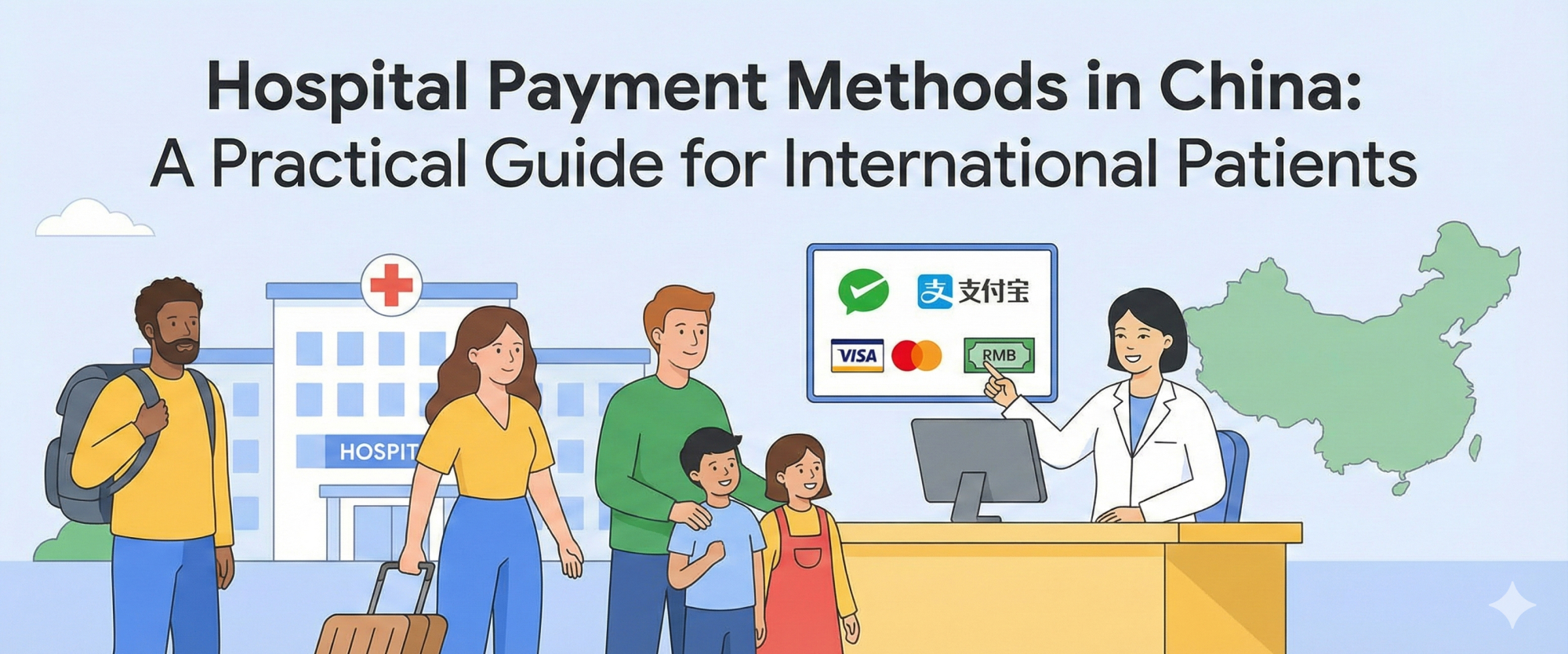
Mobile payments (Alipay / WeChat Pay) — the default in many hospitals
Across many cities, hospitals increasingly support mobile payment for the full patient journey—registration, consultation fees, tests, pharmacy, and sometimes insurance-linked settlement—through hospital apps or mini-programs.
What this looks like in practice
- A hospital staff member (or signage) directs you to scan a QR code.
- You pay inside a hospital mini-program/app and receive a digital receipt.
- You may avoid queues at cashier windows or self-service kiosks.
Good to know for international patients
- China’s official guidance for overseas visitors explicitly notes that foreign users can link international credit cards to Alipay and WeChat Pay (availability and limits can vary by user profile, card network, and risk controls).
Bank cards — UnionPay is the most widely accepted; international cards vary by hospital
- UnionPay is widely accepted across the mainland payment network and is commonly supported at hospital POS terminals.
- International card acceptance (Visa/Mastercard/AmEx/JCB, etc.) is not uniform. Many international/private hospitals and some public-hospital international clinics may support international cards, but you should not assume every cashier window in a public hospital will.
A Beijing municipal guide for international patients lists common options including RMB cash, major international credit cards, UnionPay debit cards, and WeChat Pay/Alipay.
Pro Tip: Always carry a backup method. Sometimes, hospital card terminals (POS machines) have connectivity issues with foreign networks. If you plan to swipe a card for a large surgery deposit, notify your bank beforehand to prevent the transaction from being flagged as fraud.
Cash (RMB) — still accepted, and sometimes the easiest fallback
Even in a “mobile-first” environment, cash remains a valid and sometimes crucial backup, especially if your mobile wallet fails verification or if a specific payment counter has limited card acceptance. Official payment guides emphasize that overseas visitors have multiple options including cash.
Bank transfer / corporate payment — used for planned admissions and larger bills
For elective admissions, surgery deposits, or corporate-sponsored care, hospitals may accept bank transfers to a hospital account (especially when a formal invoice/receipt process is required). This is common in structured medical-travel arrangements, though the exact workflow is hospital-specific.
Tip: For large payments, some hospitals ask you to coordinate in advance (e.g., to prepare cash handling or confirm settlement steps).
2. How hospital payment flow usually works (so you know what to expect)
Many public hospitals operate on a step-by-step settlement model:
- Registration / appointment fee (paid first)
- Consultation fee
- Tests & imaging (often paid before the test is performed)
- Pharmacy (paid before medication is dispensed)
- For inpatient care: a deposit is often required, with final settlement at discharge
China is also expanding “smart payment” models—including mobile payment integration and experiments like credit-based “treat first, pay later” in some contexts—aimed at reducing queueing and improving convenience.
3. Paying with international cards inside Alipay / WeChat Pay
Alipay (international use)
Ant Group’s Alipay ecosystem has been expanding options for overseas visitors, including the ability to bind major international bank cards to use Alipay services in mainland China.
WeChat Pay (Weixin Pay) (international use)
Tencent has publicly described efforts to broaden Weixin Pay’s merchant network accessibility for international card organizations and overseas users.
Practical notes
- Availability can vary based on country/region, card issuer, and verification rules.
- For high-value medical bills, transaction limits and risk checks can matter—so it’s wise to have at least two payment fallbacks (e.g., mobile wallet + UnionPay/cash).
Good News for 2026: Recent government policy updates have made these apps extremely foreigner-friendly. You no longer need a Chinese bank account.
- Bind Your Foreign Card: You can link your international Visa, Mastercard, JCB, or Discover card directly to the Alipay or WeChat app.
- Higher Limits: The single transaction limit for international visitors has been raised to $5,000 USD, with an annual cumulative limit of $50,000 USD.
4. Insurance: out-of-pocket vs direct billing
Public medical insurance (China’s social insurance)
China continues to expand digital tools for medical insurance settlement (including QR codes and “one-code payment” initiatives).
However, most short-term visitors and many international patients will not be eligible for China’s public insurance settlement, unless they are enrolled through employment/residency arrangements.
Commercial insurance (international plans)
Some hospitals—especially international hospitals or international departments—may offer direct billing (also called “cashless” service) for commercial insurance. Beijing’s official guidance notes that international patients may pay out-of-pocket or use commercial medical insurance, and it references direct payment services.
Important to note: Direct billing is never automatic. It usually requires:
- Pre-authorization
- Coverage confirmation
- Specific insurer/hospital agreements
- Documentation and diagnosis coding
5. Receipts, itemized bills, and what to keep for reimbursement
If you plan to claim reimbursement from an overseas insurer, keep:
- Official payment receipts
- Itemized invoice/bill
- Medical records (visit notes, procedure details)
- Test/imaging reports
- Prescription details and pharmacy receipts
China’s systems are increasingly digital, but for cross-border claims you may still need printed originals depending on your insurer’s requirements.
6. Preparation checklist (reduces delays on the day of care)
Before you arrive at the hospital, it helps to confirm:
- Which payment methods are accepted at the specific facility/department (public vs international clinic can differ)
- Whether the hospital supports WeChat/Alipay mini-program payments for registration/tests
- Whether your situation likely requires an inpatient deposit
- Whether your insurance can do direct billing, and what pre-authorization is needed
Official visitor guidance emphasizes that overseas visitors can rely on a mix of mobile payments, bank cards, and cash—the practical takeaway is to bring redundancy, not a single method.
When It Gets Complicated
For international patients, the biggest payment risk is usually not the amount—it’s the disruption: a delayed test, a delayed admission, or even a delayed discharge because the settlement steps weren’t planned in advance.
In more complex cases, payment support typically focuses on:
- Confirming accepted payment methods with the specific hospital and department ahead of time
- Planning for deposits and staged payments (especially for inpatient care)
- Preparing the documentation package needed for commercial insurance reimbursement or direct-billing review
- Reducing in-hospital waiting and rework by aligning billing steps with the planned care schedule
GET IN TOUCH
Get Payment-Ready Before Your Hospital Visit
We can help you confirm accepted payment methods, plan for deposits and staged payments, and prepare the documents you may need for reimbursement.
FAQ: Hospital Payment Methods in China
Q1. Can I pay by Visa or Mastercard at Chinese hospitals?
It varies by hospital and department. International card acceptance varies by hospital and by department (public outpatient cashier windows are often more limited than international clinics). For reliability, prepare at least one backup method such as a mobile wallet (Alipay/WeChat Pay) or RMB cash.
Q2. Can foreigners use Alipay or WeChat Pay to pay hospital bills in China?
In many cases, yes. Many hospitals support QR-code or in-app payments for registration, consultations, tests, and pharmacy. Overseas visitors may be able to bind eligible international bank cards to Alipay/WeChat Pay, but verification rules and transaction limits can apply.
Q3. Do I need to pay before treatment?
Often, yes—especially in public hospitals. Commonly, you pay in steps: registration/appointment → consultation → tests/imaging → medications. For inpatient care, a deposit is frequently required, with final settlement at discharge.
Q4. Is cash still accepted in Chinese hospitals?
Yes. Even though mobile payment is widely used, RMB cash remains an accepted method and is a practical fallback if card/mobile payments fail or are not supported at a specific counter.
Q5. What is an “inpatient deposit,” and how is it settled?
An inpatient deposit is an advance payment collected before or shortly after admission to cover anticipated expenses. During hospitalization, charges are deducted against the deposit, and the balance is settled when you are discharged (you may need to top up if costs exceed the deposit).
Q6. Can my international health insurance pay the hospital directly (cashless/direct billing)?
Sometimes, but it depends on whether the hospital has a direct-billing arrangement with your insurer and whether your case is pre-authorized. Many patients still pay first and claim reimbursement later, especially in public hospitals.
Q7. What documents should I keep for insurance reimbursement?
Keep all official receipts, itemized billing/invoices, medical records (visit notes, discharge summary), test/imaging reports, and prescription/pharmacy receipts. Some insurers require originals, so store paper copies carefully even if you also receive digital receipts.
Q8. Are refunds possible if I pay for a test or appointment I don’t complete?
Often, yes, but policies vary by hospital and by item. Refunds may require the original receipt, a cancellation confirmation, and processing at a designated cashier window—so allow extra time.
Q9. What’s the best way to avoid payment-related delays on the day of care?
Have at least two payment options ready (e.g., Alipay/WeChat Pay + cash or UnionPay), confirm whether an inpatient deposit is required, and bring your passport and booking details so staff can match your payments to your patient ID.
Key Takeaways
China offers multiple hospital payment routes—mobile payment is increasingly central, UnionPay remains widely accepted, international card acceptance varies by facility, and cash is still a reliable fallback. Official policy direction is clearly toward simpler, more integrated “smart payment” experiences in healthcare.