
International patients seeking orthopedic care in China face an immediate decision: travel for an initial consultation and imaging, or submit existing records for specialist review before planning a trip.
Some patients hold MRI, X-ray, or CT files. Others present only with pain, reduced movement, a sports injury, or a local doctor’s preliminary note. OECD reports track long waits for specialist appointments and elective procedures globally, with hip replacement waiting times reaching several months in some countries in 2024.
China’s orthopedic route bypasses the general practitioner referral pathway common in Europe or North America. Patients directly select a hospital department or subspecialty. The specialist evaluates symptoms, examines the patient, reviews imaging, and plans the next clinical step.
This guide details both the consultation and the remote review routes, maps the main orthopedic subspecialties, lists exact documents to prepare, and outlines practical details to confirm before travel.
Three Starting Points for Orthopedic Care in China
Patients arrive with different files in hand.
| Current status | Actionable path |
|---|---|
| Pain, swelling, stiffness, numbness, weakness, limited walking, a suspected injury, or a short note from a local doctor | Orthopedic consultation in China, followed immediately by imaging or tests ordered by the specialist |
| Older X-rays, a written report, medication history, therapy notes, or mixed opinions | Consultation plus record sorting, updated imaging, and specialist review |
| MRI, X-ray, CT, a diagnosis, surgery advice, previous operation records, or implant information | Specialist review of existing records to determine the value of traveling for an in-person assessment |
A patient presenting with knee pain requires weight-bearing X-rays. A patient with radiating leg pain requires a spine MRI. A sports injury requires physical examination before the doctor selects the specific scan. Starting with symptoms supports a clear clinical plan; the route simply begins with examination rather than pre-existing data.
Partial records require updates. A scan from months ago offers historical context, while current symptoms dictate the need for new imaging.
Why China’s Route Works Differently
Many healthcare systems require a primary care visit, followed by a referral, imaging, and finally a specialist review. NHS England and Public Health Scotland publish monthly waiting-time statistics reflecting these sequential steps for key diagnostic tests like CT and MRI.
Chinese hospitals organize orthopedic care directly by subspecialty. The specialist orders imaging during the initial consultation and reviews the results immediately within the same visit cycle.
Patients traveling to China with new symptoms must budget time for examination and imaging. Patients holding complete medical files must format their records for immediate specialist review.
Main Orthopedic Directions
The National Health Commission sets strict standards for regional orthopedic medical centers to expand high-level care access. Patients must match their specific condition to a defined subspecialty rather than seeking a general “orthopedic surgery” department.
| Orthopedic direction | Common situations | Clarify this first |
|---|---|---|
| Joint replacement | Hip or knee arthritis, shorter walking distance, pain during daily activity, concerns after a previous replacement | Determine the need for updated imaging, surgical assessment, or revision evaluation |
| Spine care and surgery | Neck pain, back pain, leg pain, numbness, weakness, disc disease, stenosis, scoliosis, or deformity | Correlate symptoms with current imaging and physical examination findings |
| Sports medicine | Meniscus tear, ligament injury, shoulder instability, tendon injury, return-to-sport concerns | Evaluate the need for rehabilitation review, injection therapy, arthroscopy, or an updated MRI |
| Pediatric orthopedics | Scoliosis, gait changes, limb length difference, developmental concerns, deformity | Compile growth history, standing images, gait videos, and rehabilitation notes |
| Complex revision | Failed implant, postoperative pain, instability, infection concern, hardware concerns | Identify what the previous surgery involved and which findings explain the current problem |
| Orthopedic second opinion | Existing diagnosis, surgery advice, mixed opinions, major treatment decision | Define the exact clinical question the specialist needs to answer |
Specialty choice depends on the symptom pattern, age, and treatment history. A “knee problem” involves arthritis, ligament tears, meniscus injuries, deformities, or implant failures. The same subspecialty logic applies to spine symptoms, shoulder injuries, and pediatric care.
If You Need Consultation and Imaging in China
Patients experiencing delays before diagnosis—holding only a preliminary opinion or facing pain without scans—arrive in China needing both assessment and imaging. These patients select a specific department and map out a defined visit plan.
A standard orthopedic visit includes:
- Department selection. The patient selects the orthopedic line matching the symptom: joint, spine, sports medicine, pediatric orthopedics, or trauma.
- Doctor consultation. The specialist maps pain, function, injury history, nerve symptoms, walking distance, prior treatments, and daily limits.
- Physical examination. The specialist checks movement, strength, tenderness, instability, gait, and nerve signs.
- Imaging and tests. The specialist orders X-rays, MRIs, CTs, ultrasounds, or blood tests based on physical findings.
- Result review. The specialist connects the new images directly to the symptoms.
- Next-step discussion. The treatment plan involves medication, rehabilitation, injections, hospital admission, or surgical evaluation.
Bring all local notes. A medication list, allergy history, injury timeline, and symptom diary help the doctor execute the correct examination route.
If You Already Have Imaging or Surgery Advice
Specialist review serves patients holding complete medical files, including MRIs, X-rays, CTs, surgical advice, or previous operation documents.
National Health Commission policies strictly define remote medical services and internet diagnosis. A remote review evaluates existing files to:
- Match the case to the exact subspecialty
- Check image quality for clinical assessment
- Identify missing records
- Frame specific questions before the in-person visit
- Compare a proposed operation with available evidence
- Prepare travel logistics based on clinical needs
Remote reviews evaluate submitted files. In-person visits provide physical examinations, new tests, and immediate hospital assessment.
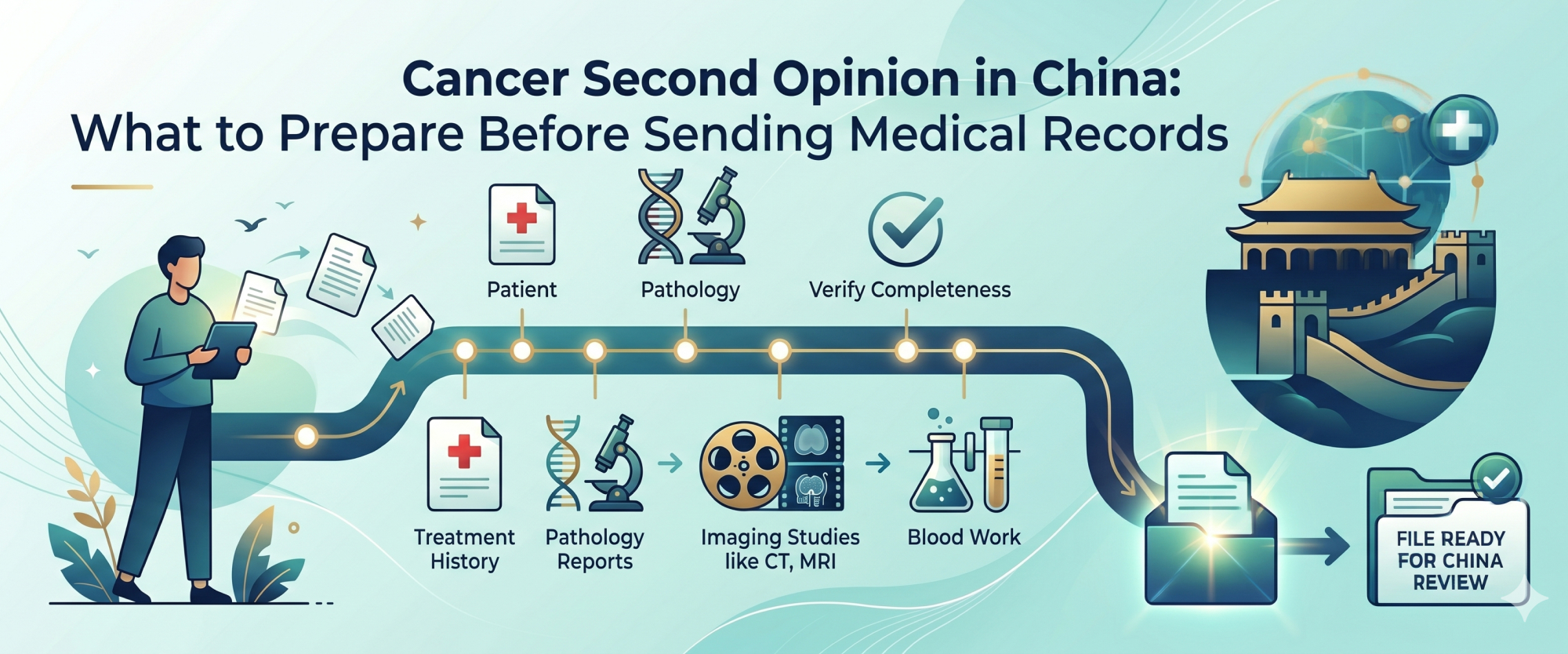
Records and Imaging to Prepare
National Health Commission rules define medical records as outpatient notes, lab results, imaging files, inpatient summaries, and surgical documents. Hospitals provide copying services for these files.
A complete orthopedic file combines symptom timelines, original images, treatment history, and surgical notes.
| Situation | Required materials |
|---|---|
| Symptoms at the starting point | Pain location, symptom timeline, injury date, walking distance, movement limits, numbness or weakness, current medications, allergies |
| Preliminary diagnosis | Local doctor note, diagnosis name, treatment advice, medication or therapy history |
| Existing imaging | Original DICOM MRI, X-ray, CT, or ultrasound files, plus written reports |
| Previous surgery | Operation note, discharge summary, implant details, follow-up images, complication history |
| Pediatric case | Growth history, gait videos, standing X-rays, brace history, rehabilitation notes |
| Sports injury | Injury mechanism, return-to-sport goal, MRI files, rehabilitation progress, instability or locking symptoms |
| Spine symptoms | Symptom map, MRI or CT, standing X-rays, nerve symptoms, walking tolerance |
Original image files hold more value than written reports. Scans allow specialists to directly inspect alignment, joint spaces, disc levels, ligament conditions, implant positions, bone healing, and deformity angles.
What Comes Before Surgery and Price Discussions
Patients frequently ask about surgery schedules and costs immediately. Clinical evaluation precedes these estimates.
The specialist evaluates:
- Symptom impact on daily life, work, sleep, walking, and sport
- Physical examination findings
- Correlation between current imaging and symptoms
- Previous treatment attempts
- Impact of prior surgeries or implants on the current problem
- General health, medications, bone quality, and infection risks
- Post-visit follow-up and rehabilitation requirements
Hospital protocols govern all surgeries. National standards mandate surgical grading, doctor authorization, preoperative board discussions, safety checks, perioperative management, and strict follow-up.
Treatment plans emerge strictly from consultations, physical examinations, record reviews, and hospital protocols. Pricing and scheduling rely entirely on the final clinical plan, required tests, implant choices, admission duration, and insurance parameters.
What to Confirm Before Planning Travel
Patients must coordinate both clinical and logistical steps. Ask these specific questions:
| Topic | Questions to ask |
|---|---|
| Specialty direction | Which orthopedic subspecialty fits the case? |
| Imaging plan | Does imaging happen before travel, during the China visit, or both? |
| Records | Which files require uploading before the appointment? |
| Language support | How does the hospital handle report explanations, consent discussions, and follow-up instructions in English? |
| Time window | Does the schedule accommodate consultation, imaging, result review, and follow-up? |
| Payment and insurance | Which payment methods work, and what specific documents does the insurer require? |
| Recovery and handoff | Which rehabilitation steps happen in China, and which steps continue at home? |
Patients must collect complete records before departure: reports, DICOM image files, doctor notes, prescriptions, itemized invoices, and discharge summaries. These documents support home-country care and insurance claims.
GET IN TOUCH
Planning Your First Orthopedic Step in China?
If you are comparing consultation, imaging, record review, or an in-person orthopedic assessment in China, prepare your current symptoms, records, travel window, and key questions before arranging the next step.
FAQ
Can I come to China for orthopedic consultation with symptoms or a preliminary diagnosis?
Yes. Patients presenting with pain, movement limits, numbness, or a local doctor’s note undergo a physical examination first. The specialist then orders targeted X-rays, MRIs, or CT scans. Bring local notes, medication histories, allergy records, and a specific symptom timeline.
Should I start with a China visit or a specialist review of existing records?
Start with a physical visit if imaging is missing or outdated. Request a specialist review if you hold recent MRIs, CTs, surgical notes, and imaging reports.
What orthopedic problems do international patients often ask about in China?
International patients frequently seek joint replacement, spine care, sports medicine, pediatric orthopedics, deformity correction, and revision surgeries. The body part, age, imaging, and treatment history dictate the specific subspecialty choice.
Is an MRI report enough for orthopedic review?
Original DICOM image files provide far more value than written reports. Radiologists summarize findings in reports, but orthopedic specialists must inspect the actual structures directly to plan treatment. Always submit image files alongside reports.
What should I prepare if I had orthopedic surgery before?
Compile the operation note, discharge summary, implant details, recent X-rays or CTs, infection records, and a symptom timeline. Revision evaluations rely entirely on details from the initial operation.
Can a remote orthopedic review decide my treatment plan?
Remote reviews frame the case, identify the correct subspecialty, and verify record completeness. Final treatment plans require in-person clinical assessment, physical examination, and hospital safety protocols.
What should I confirm before traveling to China for orthopedic care?
Confirm the subspecialty, imaging schedule, language support, payment method, and insurance requirements. Surgical patients must also coordinate admission assessment, caregiver support, discharge documentation, and rehabilitation logistics.
How can partial orthopedic records support the first consultation?
Bring all available files. The specialist reviews them to determine exactly which new images or history details will complete the assessment. Spine symptoms, pediatric deformities, and revision surgeries demand this specific gap-analysis during the first visit.