


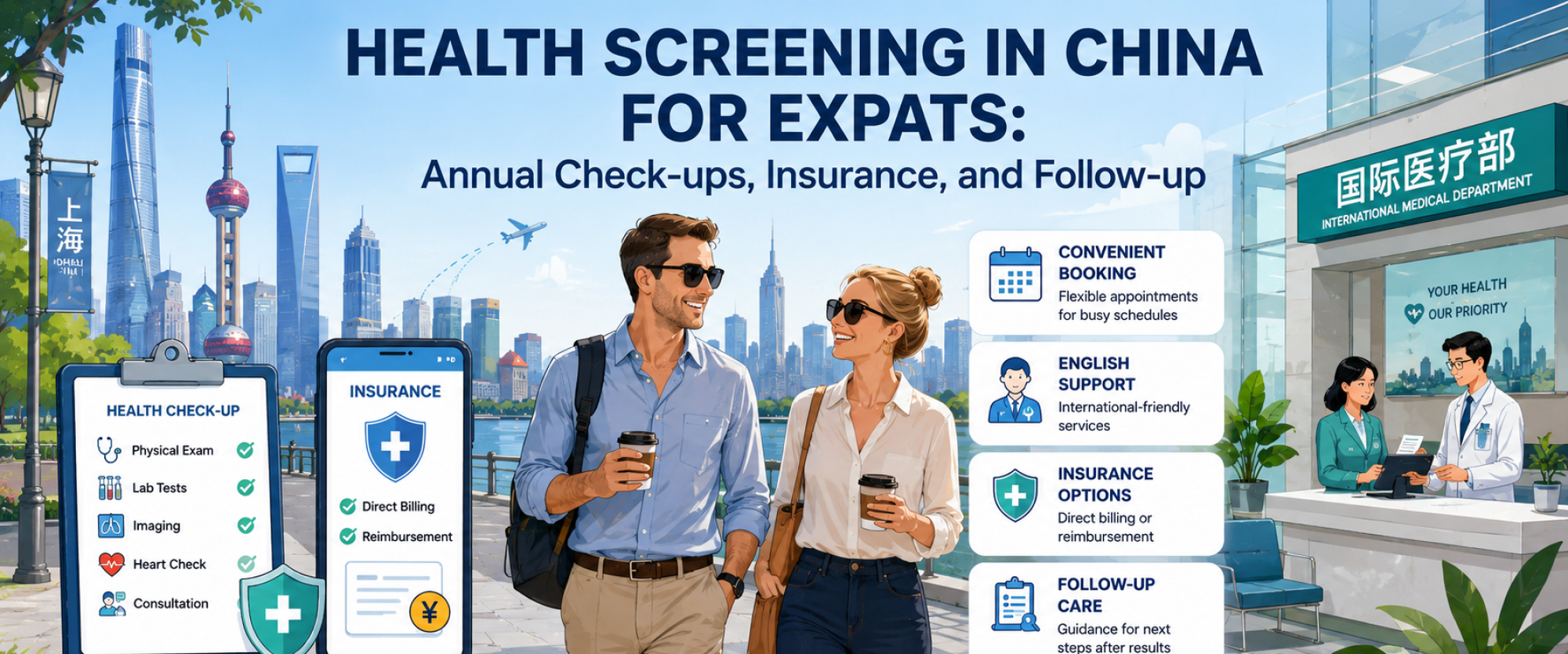
Annual health screening for expats in China involves more than selecting a medical package. The report language, insurance billing procedures, fāpiào collection, and follow-up options determine the check-up’s actual clinical value.
This guide outlines elective annual screening processes for foreign employees, long-term residents, international school families, and HR teams organizing staff check-ups.
Annual Screening, Visa Medical Exams, and Occupational Checks Are Different
Expats in China encounter multiple health check categories. The administrative purpose defines the exact clinical process.
For a broader overview of elective health screenings, mandatory examinations, booking routes, and common preparation steps, see Health Check-ups in China: A Complete Guide for International Visitors.
| Type | Main purpose | Usual route |
|---|---|---|
| Elective annual health screening | Personal health review, employer benefit, family health planning | Health examination center, international department, or private international facility |
| Visa or residence-related medical examination | Administrative requirement for certain visa or residence processes | Designated official examination route |
| Occupational health check | Job-related health and safety requirement | Employer-arranged occupational health process |
| Disease-specific screening | Screening for a defined risk group or condition | Program-specific clinical route |
The following sections focus exclusively on elective annual screening. Visa, residence permit, and job-requirement health checks follow separate, mandatory official instructions.
Where Expats Usually Arrange Annual Health Screening
Most expats compare three settings: public hospital health examination centers, international departments inside public hospitals, and private international facilities.
For a fuller comparison of these settings, see Health Check-ups in China: Comparing Public vs. Private Options. The short version for expat annual screening is this:
| Setting | What it often suits | What to confirm first |
|---|---|---|
| Public hospital health examination center | Standard annual screening inside a hospital-based system | Report language, registration process, payment, document pickup, follow-up route |
| Public hospital international department | Hospital-based screening with more guided communication | English support, direct billing, report review, access to outpatient departments |
| Private international facility | Families, corporate plans, English communication, report discussion | Package scope, pricing, insurer network, referral process, document set |
Public hospital health examination centers
These centers often run a station-based check-up flow: registration, blood draw, urine testing, ECG, ultrasound, imaging, physical examination, and other package items. They may suit people who want a standard annual review in a hospital setting.
Standard public-facing workflows may run mainly in Chinese. If English matters, ask whether support covers only registration or extends to the report, result explanation, and follow-up booking.
International departments inside public hospitals
International departments usually offer more appointment support and language coordination than standard public-facing services. For expats who may need follow-up inside the same hospital system, this route can make the next step easier to arrange.
Direct billing may also be easier here than in a standard public health examination center, but coverage still depends on the facility, insurer, plan, and service type.
Private international facilities
Private international facilities often place more time around communication, scheduling, and report explanation. English or bilingual reporting may also be easier to arrange.
The trade-off is usually cost and insurance complexity. Some facilities support direct billing for selected insurers. Others work on a pay-and-claim basis. Confirm the insurer network and claim documents before booking.
Package Names Matter Less Than the Item List
Facilities label packages with terms like “premium,” “executive,” and “deep screening,” but the actual item list determines the screening’s medical value.
China’s adult health check-up guidance uses a more useful structure: a health questionnaire, basic check-up items, and risk-based screening items. In practice, annual screening should reflect age, medical history, family history, lifestyle, current medications, and any previous abnormal results.
A 30-year-old teacher, a 45-year-old executive with high blood pressure, a 52-year-old smoker, and a family arranging check-ups together do not need the same screening logic.
Before choosing a package, check:
- which tests every patient receives;
- which items depend on age, sex, or risk profile;
- whether advanced imaging needs a separate appointment;
- whether endoscopy, sedation, or specialist consultation sits outside the package;
- whether the package includes report explanation;
- whether the report can support insurance or overseas follow-up.
If a symptom already needs medical attention, a routine screening package may be the wrong starting point. A clinic visit gives a doctor more room to assess the problem directly.
Confirm English Report Formats
“English report available” can mean several things.
| Report option | What it may include |
|---|---|
| Chinese report only | Standard report in Chinese, often enough for local follow-up |
| Bilingual summary | Key findings or the conclusion translated into English |
| Full bilingual report | Individual results and final conclusion in both languages |
| English explanation session | A doctor, GP, or care team explains the result in English |
| Certified translation route | A later translation prepared for overseas medical or insurance use |
The most useful section for follow-up is often the final conclusion or reviewing physician’s summary. That section pulls individual results into one assessment and gives follow-up guidance. If the English version only translates the item names and leaves the conclusion unclear, the report may be harder to use outside China.
For a detailed explanation of Chinese health check-up reports and how to read the conclusion section, see Health Check-up Results in China: Reading Your Report and Using It.
Before booking, ask:
- Does the facility issue English reports as a standard service or an add-on?
- Does the English version include the final conclusion?
- Will the report show the physician signature and facility stamp if needed?
- Can the facility provide both digital and printed copies?
- How long does the English version take?
- Who explains abnormal or borderline results?
Insurance: Direct Billing, Pay-and-Claim, and Employer Benefits
Insurance for annual screening depends on the plan. Some commercial health plans cover preventive screening. Some cover only selected items. Some require pre-authorization. Some exclude routine screening but cover follow-up visits after an abnormal finding.
For a full guide to insurance structures, see Medical Insurance & Reimbursement in China: A Practical Guide for Expats and Visitors.
Direct billing
Direct billing means the facility settles eligible charges with the insurer directly. The patient may still pay deductibles, co-payments, or non-covered items.
The direct billing process requires three matching conditions:
- the facility has an agreement with the insurer;
- the patient’s plan covers the service;
- the service type qualifies under the policy.
A facility may support direct billing for outpatient care but handle annual screening as self-pay. Confirm this before the appointment.
Pay-and-claim
Pay-and-claim means the patient pays first and submits documents afterward. This route depends heavily on paperwork. The insurer may ask for the report, fāpiào, itemized expense list, and sometimes additional medical documentation.
For claim documents, see Insurance Claims in China: fāpiào, Receipts, and Medical Documents You Need.
Employer-arranged screening
Some companies arrange annual screening as an employee benefit. The employer may handle payment directly, reimburse employees later, or coordinate with an insurer. HR teams should define the document process before employees attend, especially when staff members have different insurers.
Payment and Documents to Prepare
Facilities accept various payment methods, including Alipay, WeChat Pay, UnionPay cards, cash, and international credit cards. For a broader payment guide, see Hospital Payment Methods in China: A Practical Guide for International Patients.
Bring these items to the appointment:
- passport;
- appointment confirmation;
- insurance card or policy details;
- medication list with dose and frequency;
- allergy list;
- key medical history;
- previous reports or imaging files if relevant;
- at least two payment options.
Collecting the complete document set during the visit supports future insurance claims and overseas medical reviews.
| Document | Chinese term | Why it matters |
|---|---|---|
| Health check-up report | 体检报告 | Main screening record |
| Conclusion or summary section | 主检报告 / 总检结论 | Starting point for follow-up |
| Lab reports | 检验报告 | Useful for comparison over time |
| Imaging reports | 影像报告 | Written interpretation of imaging tests |
| Imaging files, if applicable | 影像资料 | Useful when another doctor needs to review the scan itself |
| Official invoice | 发票 / fāpiào | Core billing document for many claims |
| Itemized expense list | 费用清单 | Shows what the total charge includes |
Ask the facility how to retrieve original digital imaging files. Specialists reviewing cases later require the raw images, rather than just the written interpretation. For a fuller records guide, see Medical Records & Imaging in China: A Guide for International Patients.
When the Report Shows an Abnormal Result
A screening result is not the same as a diagnosis. It raises a question. A doctor’s consultation, repeat test, specialist review, or further examination answers it.
Chinese check-up reports often use a small set of follow-up terms:
| Report wording | Usual next step |
|---|---|
| 复查 / recheck | Repeat the test after a defined period or under better-controlled conditions |
| 随诊 / follow-up review | Monitor the finding and arrange review later |
| 就诊 / clinic or specialist visit | See the relevant department for clinical assessment |
| 进一步检查 / further testing | Add tests to clarify the finding |
A recheck may stay within the screening center’s workflow. A specialist visit moves into outpatient care. That may require a separate appointment with a different department.
Expats consulting regular physicians outside China rely on portable medical files. Keep the final report, conclusion section, key lab pages, imaging reports, digital imaging files, fāpiào, and itemized lists together.
For follow-up inside China, ask the screening facility:
- Which department should review this finding?
- How soon should the next appointment happen?
- Can the facility help arrange the outpatient visit?
- Should the patient bring imaging files or only the written report?
- Will the follow-up visit use insurance or self-pay?
For Families and Long-term Residents
Families often arrange annual screening around school calendars, work schedules, and travel windows. Adults and children may need different routes. A general adult screening package may not fit a child, a pregnant patient, or someone with a known chronic condition.
For family screening, confirm:
- which age groups the facility serves;
- whether children need a pediatric route;
- whether reports come separately for each family member;
- which parent or guardian can collect records;
- whether each person receives separate billing documents;
- whether follow-up can be arranged for different departments.
For adults managing chronic conditions, bring recent reports and a medication list. A screening result makes more sense when the reviewing physician can compare it with prior data.
For HR Teams Arranging Expat Screening
HR teams establish administrative workflows before sending employees for screening. The package contents, report format, and follow-up channels hold more value than the baseline price.
| Area | What HR should define |
|---|---|
| Scope | Which items every employee receives, and which items vary by age, sex, or risk |
| Consent | How employees choose optional items |
| Privacy | Who receives individual reports and how medical information is protected |
| Language | Whether employees receive Chinese, English, or bilingual reports |
| Follow-up | How employees can access result explanation or referral |
| Insurance | Whether the plan uses direct billing, pay-and-claim, or employer settlement |
| Documents | Whether each employee receives fāpiào, itemized list, and report copies |
For international staff, one standardized package may not fit everyone. A better program gives employees a clear report, a usable document set, and a defined route if a result needs follow-up.
Before Booking: A Short Checklist
Before confirming an annual screening in China, check:
- facility type and location;
- package item list;
- fasting and preparation rules;
- passport or ID requirements;
- report language and delivery time;
- report explanation format;
- follow-up route after abnormal results;
- insurance coverage and direct-billing status;
- fāpiào and itemized expense list;
- digital and printed report options;
- imaging file retrieval, if imaging forms part of the package.
GET IN TOUCH
Planning an Annual Health Screening in China?
Annual screening works best when the package, report language, insurance route, and follow-up plan fit the same purpose. Before booking, make sure the results can support the next step—whether that means local follow-up, an overseas doctor’s review, or an insurance claim.
FAQ
Q1. Can expats use China’s public medical insurance for annual health screening?
Sometimes, but coverage varies by city, employer, facility, and check-up type. Many annual screenings still run through employer benefits, commercial insurance, or self-pay. Confirm the billing route before booking.
Q2. Can international insurance cover an annual check-up in China?
Some plans cover preventive screening; some cover only follow-up care after symptoms or abnormal results. Direct billing also depends on the facility and plan. Ask the insurer whether annual screening is covered before the visit.
Q3. What if the facility does not support direct billing?
Use pay-and-claim. Pay first, then collect the report, fāpiào, itemized expense list, and any supporting medical documents before leaving the facility.
Q4. Can I get an English report?
Often, but not everywhere. Ask whether the facility provides a full English report, a bilingual summary, or only English explanation. The conclusion section matters most for follow-up.
Q5. What happens if my report shows an abnormal result?
Check the conclusion section first. It may recommend a repeat test, follow-up review, specialist visit, or further testing. Ask which department should handle the next step.
Q6. What should HR teams confirm before arranging check-ups for expat employees?
Confirm package scope, report language, privacy rules, insurance handling, document collection, and follow-up support. One group package may still need adjustments by age, sex, and risk profile.