
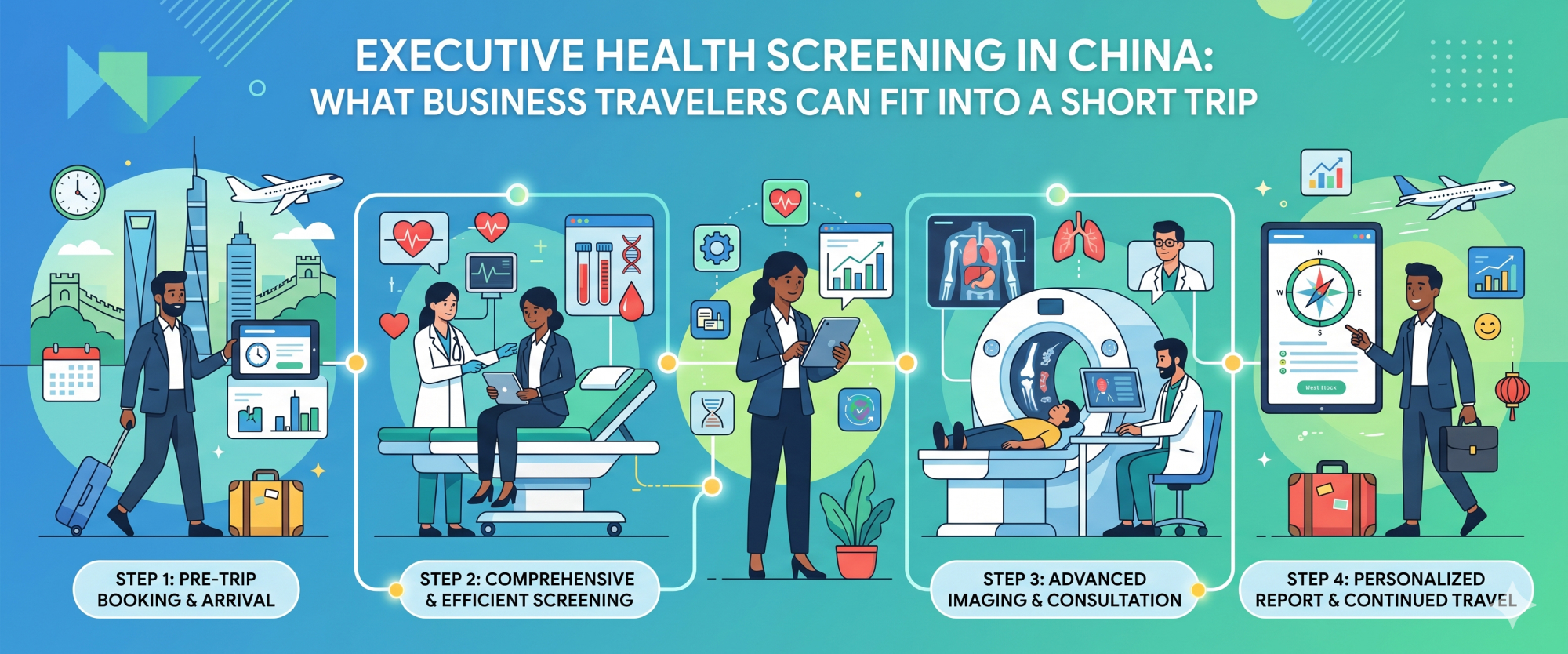
On many China business trips, the only realistic opening is an early morning before the day fills up. That slot can work for health screening if the fasting window, appointment flow, report timing, and follow-up route are clear before booking.
In China, a health check-up is a formal medical service. National health regulations define it as a medical process that uses examinations to assess health status and identify early signs of disease or health risk. Licensed institutions that provide health check-ups must have the right clinical departments, staff, equipment, and registered service scope. For a broader introduction to how health check-ups work in China, including mandatory and elective screenings, booking routes, and common preparation steps, see Health Check-ups in China: A Complete Guide for International Visitors.
For business travelers, the first decision is scope. The practical question is: what can be done within the available time, and what should be scheduled on its own?
What “executive health screening” means in China
In China, “executive” usually describes the service setup. It often means scheduled appointments, guided check-in, language support, report explanation, and help arranging the next step when a result needs review.
The medical content still follows adult health screening rules. China’s 2025 adult health check-up guidance describes three layers: a self-assessment questionnaire, basic examination items, and risk-based screening for chronic diseases such as cardiovascular and cerebrovascular disease, common cancers, chronic respiratory disease, and diabetes. The same guidance asks institutions to adjust items according to the person’s health needs, available staff, and equipment.
The item list matters more than the package label. A “premium” or “VIP” label helps only after the exact test list, report format, and review process are clear. The exact tests, report language, review process, and follow-up route matter more.
The setting also shapes the experience. Travelers comparing public hospital health examination centers, international departments, and private facilities may want to read Health Check-ups in China: Comparing Public vs. Private Options.
How much time to leave for screening
Many morning screenings are built around a half-day slot, especially when blood work and abdominal ultrasound start the visit. The timing changes with the facility, package, imaging schedule, queue, and same-day physician review.
| Trip window | What can usually fit | What to schedule separately |
|---|---|---|
| One free morning | Basic physical examination, blood and urine tests, ECG, selected ultrasound, basic imaging, body measurements | Full report discussion, selected imaging, specialist consultation |
| One full day | Broader screening, some same-day report review, selected add-ons when scheduled in advance | Tests with later reports, follow-up consultation, further testing |
| Several days in one city | Screening, report pickup, result explanation, and selected follow-up questions | Endoscopy, sedated procedures, pathology-related results, multi-visit review |
A morning appointment usually works well when fasting tests start the day. Official health education materials and hospital guidance commonly note that blood work and abdominal ultrasound may require fasting, often around 8–12 hours depending on the test and facility. People taking medication for diabetes, blood pressure, heart disease, anticoagulation, or other long-term conditions should confirm medication instructions before the appointment.
One free morning may be enough for a basic screening. Extra time after report release makes result questions easier to handle before departure.
What can fit into a short business trip
For a short trip, screening is most useful as a baseline review. It records current health markers, flags common risk signals, and gives the traveler a reference point for later comparison.
Basic screening items
China’s adult health check-up guidance lists basic items across physical examination, laboratory testing, and auxiliary examinations. These may include height, weight, waist and hip measurements, blood pressure, pulse, internal medicine and surgical checks, blood and urine testing, stool occult blood testing, liver and kidney function, lipids, glucose, uric acid, thyroid-related testing, ECG, radiology, ultrasound, and body composition analysis. For adults over 40, the guidance adds pulmonary function and bone density to the basic recommended set.
For business travelers, this screening usually serves three practical purposes:
- establish a current health baseline during the China trip
- check common metabolic and cardiovascular risk markers
- identify results that deserve follow-up after the trip
Risk-based items
Risk-based screening should follow the traveler’s age, family history, symptoms, smoking history, prior abnormal results, and personal health goals. The add-ons may include cardiovascular assessment, lung screening, selected cancer-related screening, thyroid testing, bone density, or targeted imaging, depending on the traveler’s profile.
The 2025 adult guidance places these items after self-assessment and basic examination. This order keeps the package from becoming a random list of tests. Risk-based screening should answer the traveler’s actual risk questions, not just add more items to the bill.
Items that need a separate time block
Some tests need their own slot during the trip. They involve preparation, recovery, later reporting, or department-specific review.
Gastroscopy or colonoscopy
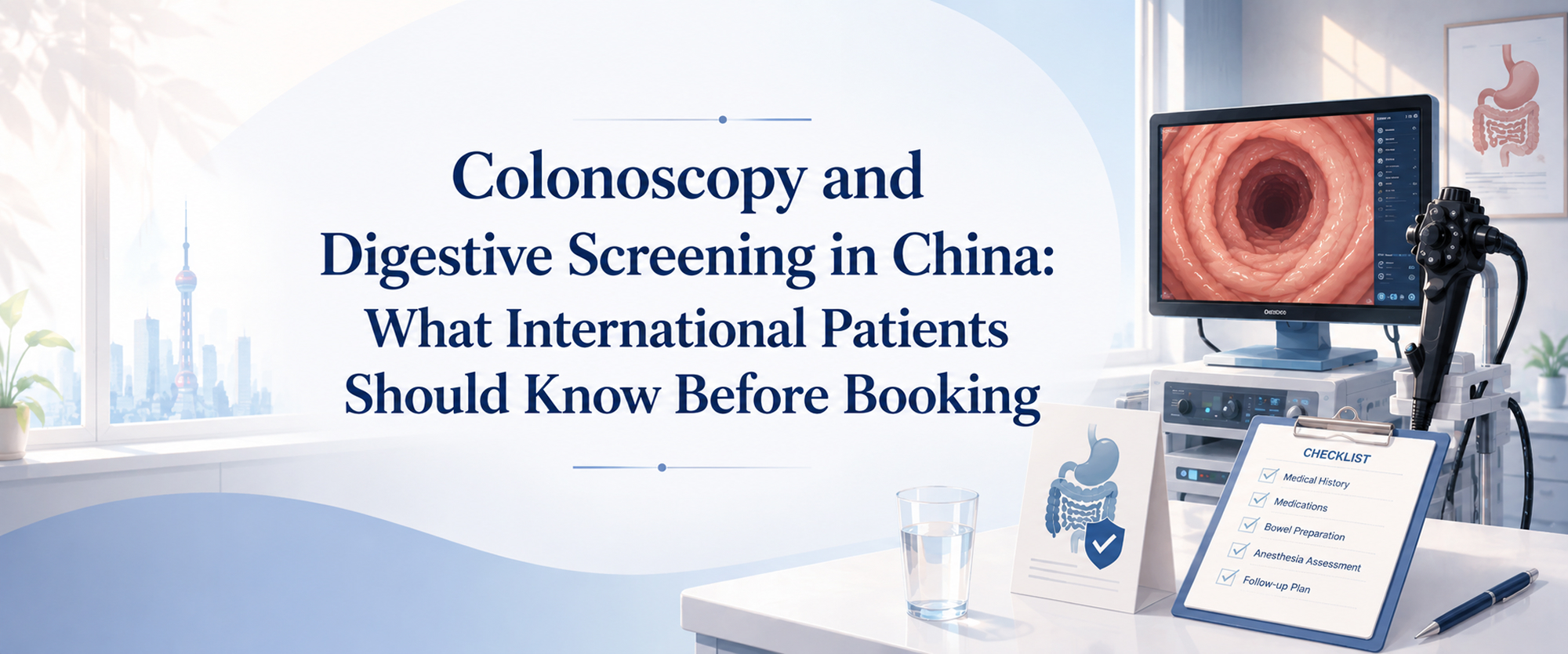
Digestive screening may be useful when age, symptoms, or history point to it. Endoscopy should usually be planned as its own appointment. Colonoscopy requires bowel preparation. Sedated gastroscopy or colonoscopy usually involves anesthesia assessment, post-procedure observation, and an escort after the examination. Official hospital guidance also asks patients to leave driving and certain activities until the recommended recovery window has passed after sedated endoscopy.
Colonoscopy is usually discussed when age, family history, symptoms, prior polyps, or other risk factors make colorectal screening relevant. Gastroscopy involves a separate risk discussion. Before booking either procedure during a business trip, confirm preparation, sedation, escort, recovery time, and report timing.
Advanced imaging
CT, MRI, cardiac ultrasound, and other selected imaging tests may need separate appointment slots. Some reports take longer than routine blood work. If prior imaging already exists, bring both the written report and the original image files when relevant.
Specialist consultation
Screening can raise a question. A specialist visit looks at that question in a clinical setting. When a result points to a clinical issue, the next step may be outpatient review, repeat testing, or a department-specific consultation.
How to choose the right screening scope
Build the screening around the schedule first, then the traveler’s health profile, then the package.
Start with the trip schedule
Before choosing a package, check these details:
- arrival time and jet lag
- fasting window
- meeting schedule after the appointment
- report delivery timing
- digital access after leaving China
- flight timing if a result needs follow-up
A traveler landing late at night may prefer the second morning for screening. A traveler with a major afternoon meeting should place sedated procedures, long imaging slots, and follow-up consultations on another day.
Match the package to risk
The self-assessment step carries real weight. Prior diagnoses, family history, smoking status, medications, allergies, past surgeries, and recent symptoms can change which items make sense. National guidance puts this information at the start of adult health check-up planning.
Where screening stops and clinical diagnosis begins
A screening report can point to a finding for review. A doctor makes a diagnosis after clinical evaluation, sometimes with further testing. A flagged lab value, imaging note, or ECG finding gives the doctor a starting point.
What to confirm before booking
For a short business trip, the practical details need to be clear before booking. Confirm the practical details before choosing the appointment time.
| Question to ask | Why it matters |
|---|---|
| What time should fasting begin? | Blood work and abdominal ultrasound often shape the whole morning schedule. |
| Which items can finish on the same day? | Some imaging or specialized reports may come later. |
| Does the appointment include physician review? | A reviewed conclusion brings separate results into one usable report. |
| Can the facility provide English support or an English summary? | Report language affects how easily another doctor or insurer can use the results later. |
| How will the full report arrive? | Digital access, printed copies, and stamped documents each serve a different use. |
| Can the facility issue a fāpiào and itemized expense list? | These documents may matter for insurance, employer records, or personal accounting. |
| Which payment methods work for foreign visitors? | China’s official visitor payment guidance lists mobile payment, bank cards, and cash as common options. Foreign users can link international Visa or Mastercard cards to Alipay and WeChat Pay, subject to platform rules and limits. |
| How does the facility handle flagged results? | A clear follow-up route helps travelers decide what to ask before departure and what to review at home. |
What to bring on the day
The visit usually runs more smoothly when the key information is ready in one place.
Bring:
- passport
- booking confirmation
- current medication list, including dose and frequency
- allergy list
- major diagnoses, surgeries, and recent symptoms
- prior lab reports or imaging reports when relevant
- insurance card or policy information if the visit may involve direct billing or reimbursement
- a local phone number or reliable contact method in China
Beijing’s official medical guide for foreign patients lists outpatient appointment routes, common payment options, and direct-billing possibilities when the insurer and institution have an arrangement. The same rule applies elsewhere: payment and insurance handling depend on the facility, department, insurer, and plan.
Reading and using the report
Most Chinese health check-up reports combine individual test results with a reviewed summary or conclusion section. The layout varies by facility. Start with the reviewed conclusion. National rules require examination results to carry the responsible physician’s record and signature, and the final health check-up report to receive review and signature from a qualified physician.
Before the appointment, ask:
- whether the report comes in Chinese, English, or bilingual format
- whether the English version covers the full report or only the summary
- whether the facility offers a physician explanation session
- how long each report section takes
- whether digital access works after leaving China
- whether a printed and stamped version can be collected or mailed
If the report includes an abnormal finding, read the recommended next step first. Some findings lead to repeat testing or monitoring. Others lead to outpatient review or specialist consultation. On a short trip, this planning helps the traveler decide what to ask before departure and what to bring home for later review.
For a closer look at the chief physician’s conclusion, abnormal findings, report language, and follow-up wording, see Health Check-up Results in China: Reading Your Report and Using It.
Documents worth collecting before leaving
Collect documents while still in China. It saves time later. For personal records, insurance, employer documentation, or later medical review, ask for the full set before leaving the facility.
| Document | Use |
|---|---|
| Complete health check-up report | Main medical record from the screening |
| English summary or certified translation, if needed | Easier use with an overseas doctor |
| Original imaging files, if imaging took place | Direct review by another doctor |
| Official invoice / fāpiào | Formal proof of payment |
| Itemized expense list | Shows what the invoice includes |
| Digital report backup | Useful for storage and quick sharing |
China’s invoice rules give electronic invoices the same legal effect as paper invoices. Save the original electronic file when the facility issues an e-fāpiào, and print a copy when an insurer or employer prefers paper submission.
When business-trip screening works best
A short-trip screening works well with a practical goal:
- create a current baseline
- check common health markers
- review risk-based screening needs
- collect a usable report
- identify follow-up questions
Complex symptoms, active treatment decisions, chronic pain, prior abnormal imaging, cancer history, heart symptoms, or unexplained changes usually belong in a focused medical review. In those cases, start with the existing records. Add screening only when it brings useful information.
If the results, imaging files, or printed records may need to travel with you, the document types are explained in Medical Records & Imaging in China.
GET IN TOUCH
Planning health screening around a China business trip?
Before booking, compare the available time, fasting window, report language, document needs, and follow-up route. These details show what can fit into the trip and what scope is realistic.
FAQ
Q1. Can a business traveler complete a health screening in one morning?
A basic screening can fit into a morning when the appointment starts early and fasting tests come first. The exact timing depends on the facility, package, queues, imaging slots, and report schedule.
Q2. Does “executive” mean medically better?
“Executive” usually describes scheduling, communication support, privacy, report explanation, and service flow. The value comes from matching the test list to the traveler, then reviewing the results properly.
Q3. Can the report come in English?
Some facilities offer English or bilingual reports. Others issue Chinese reports and provide separate interpretation support. Confirm the report language before booking, especially when an overseas doctor or insurer will use the document.
Q4. Should a traveler choose the biggest package?
A larger package can help when age, history, symptoms, or risk factors support the added tests. A clearer approach starts with the traveler’s risk profile and available schedule. Start with the traveler’s risk profile and available schedule.
Q5. What happens if the report shows an abnormal result?
The next step depends on the finding. A mild abnormality may fit repeat testing or monitoring. A result with higher clinical priority may call for outpatient review, specialist consultation, or further testing. Screening helps identify findings for clinical review.
Q6. Can international health insurance cover the screening?
Coverage varies by policy. Some international health plans include annual preventive screening; coverage terms vary by policy. Some facilities also have direct-billing arrangements with selected insurers. Confirm coverage before booking, and collect the fāpiào, itemized expense list, and full report if you plan to submit a claim.
Q7. What should I bring on the day?
Bring your passport, booking confirmation, current medication list, allergy list, and key medical history. If prior imaging or recent lab results may affect the screening plan, bring those as well.
Q8. Can gastroscopy or colonoscopy fit into a business-trip screening?
They can fit when the schedule and medical reason line up. These procedures need separate preparation and often involve sedation, observation, and recovery time. Set aside enough time that day. Confirm preparation rules, escort requirements, report timing, and follow-up arrangements before booking.
Q9. How can I share results with my doctor back home?
Collect the complete report before leaving the facility. Ask whether an English version or English summary is available. If imaging took place, request the image files in a format another doctor can review. Keep the report, imaging files, fāpiào, and itemized expense list together.
Q10. Do I need to fast the night before?
Most packages that include blood work and abdominal ultrasound require fasting, often around 8–12 hours depending on the facility and test items. Water is often allowed, but the facility should confirm the exact rule. Gastroscopy and colonoscopy require additional preparation.