
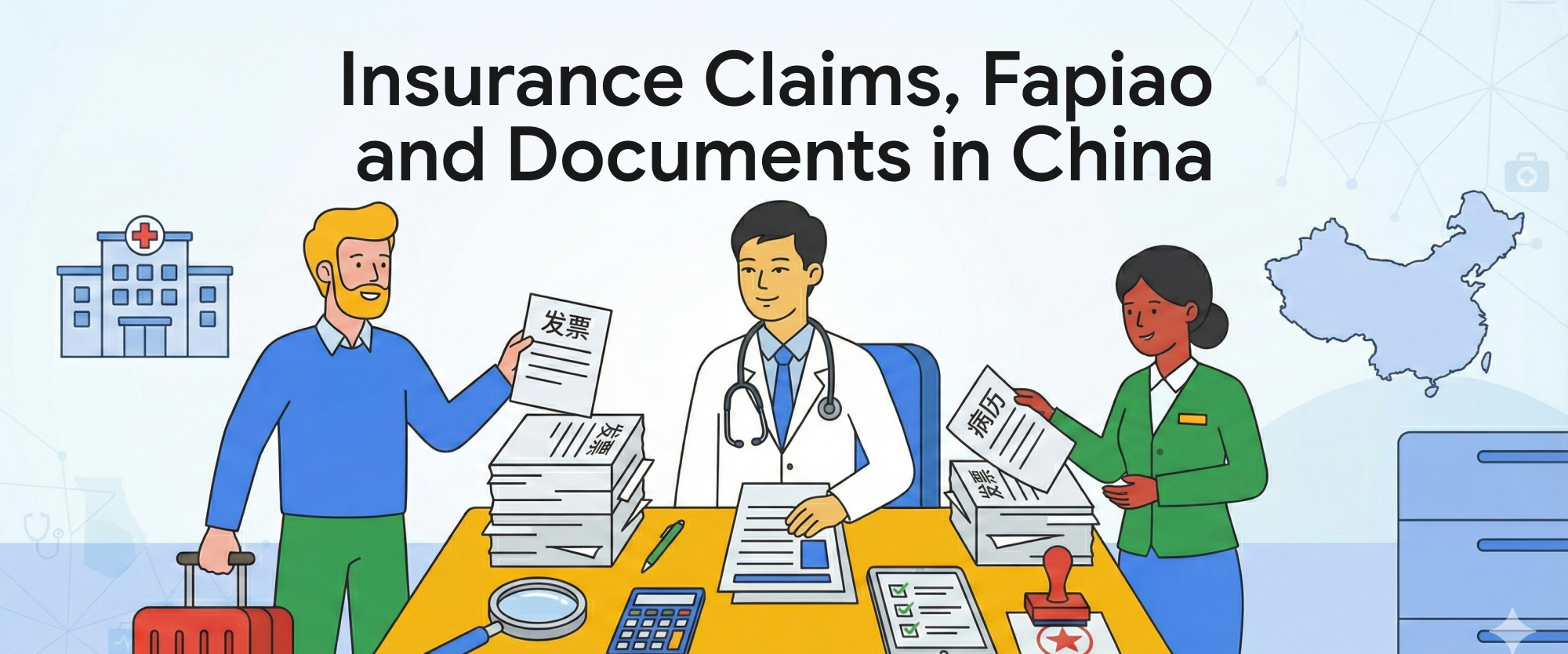
After receiving medical care in China, the last thing you want is for your insurance claim to be delayed over missing paperwork. Yet this happens more often than it should—not because patients don’t try to collect documents, but because they don’t know which documents matter most.
In China, hospitals can generate multiple types of payment records, but not all of them carry equal weight with insurance companies. The single most important term to understand is fāpiào (发票)—China’s official tax invoice.
This guide explains what a fāpiào is, why it matters for your claim, and exactly which documents to request before you leave the hospital.
1. Understanding the Fāpiào (发票) : China’s Official Invoice System
In many countries, a simple receipt proves you paid for services. China operates differently. The document that carries the strongest formal weight is the fāpiào (发票)—an official invoice issued through China’s national tax system, available in either paper or electronic format.
China has been transitioning to fully digitalized electronic invoices (e-fāpiào), which tax authorities explicitly confirm have the same legal status as paper invoices. Whether you receive paper or electronic format, both are equally valid for insurance purposes.
Why your insurer cares
Most insurers want a document that is verifiable, standardized, and officially issued. Many hospital “payment slips” are useful for tracking, but insurers may still ask for the fāpiào (and the itemized breakdown) as the formal proof.
The Three-Part Document Set Your Insurer Needs
International insurance companies have varying requirements, but there’s a consistent pattern across both Chinese government reimbursement systems and international claims: you need proof of payment + itemized details + clinical documentation. Missing any one piece can trigger delays or denials.
A) Proof of Payment (Billing Documents)
Collect these financial records:
- Fāpiào / Official Invoice (paper or electronic)
- Payment receipts if issued separately (some hospitals generate multiple payment records for deposits, services, and pharmacy)
- Final settlement statement for inpatient care, especially if deposits were involved
Even hospitals that accept direct billing with international insurers emphasize that claims still require bills plus supporting medical records and billing details for review.
B) Itemized Breakdown (What You Paid For)
A single lump sum on an invoice isn’t enough—insurers want to see what that total includes. Request these itemized lists:
For outpatient visits:
- Expense list (费用清单 / fèiyòng qīngdān)
- Prescription details (处方药单 / chǔfāng yàodān) if medications were dispensed
For inpatient care:
- Inpatient expense list (住院费用清单 / zhùyuàn fèiyòng qīngdān)
These documents appear consistently in official medical insurance reimbursement materials published by Chinese government medical security bureaus.
C) Clinical Documentation (Diagnosis and Treatment Records)
Your insurer needs medical justification for the charges. Essential documents include:
For all visits:
- Medical record excerpt / visit notes (病历资料 / bìnglì zīliào)
- Test and imaging reports (检查报告 / 影像报告 jiǎnchá bàogào/yǐngxiàng bàogào)
For hospitalizations:
- Discharge summary (出院小结 / chūyuàn xiǎojié) — this is the single most important clinical document for inpatient claims
- Operative reports or procedure notes if surgery was performed
These requirements align with standard Chinese medical insurance documentation lists.
3. Paper vs electronic: what you’ll actually receive
Depending on the hospital’s systems, you’ll get either:
- Paper fāpiào with an official stamp or registered format, or
- Electronic fāpiào (e-fāpiào) downloadable through a hospital app, SMS link, email, or China’s tax digital account system.
China’s tax authority has formalized national standards for e-fāpiào, including public verification methods. If you receive an electronic invoice, save the original file immediately and consider printing a copy—some insurance departments still prefer paper submissions.
Pro tip: You can verify any invoice’s authenticity through China’s National VAT Invoice Verification Platform, an official tax authority system (China Tax Policy Database). This can be helpful if your insurer questions document validity.
4. How to Request Documents: Timing is Everything
The golden rule: treat documentation as part of your visit, not an afterthought. Once you’ve left China, obtaining missing originals or correcting errors becomes exponentially harder.
For Outpatient Visits
Before leaving the hospital:
- Confirm the hospital will issue an official fāpiào for that day’s charges (not just a payment confirmation)
- Request the itemized expense list, especially if you made multiple payments (registration + tests + pharmacy)
- Keep original receipts if required for refunds—some hospitals explicitly need them for processing
- Collect copies of your medical record and any test/imaging reports
For Inpatient Care
At discharge:
- Obtain your discharge summary—request this explicitly, as it may not be automatically provided
- Get the complete inpatient expense list
- Collect copies of all test results, imaging reports, and operative notes
- Ensure your fāpiào covers the final settlement amount
- Double-check that all documents show your name exactly as it appears on your passport
5. Medical record copies: if your insurer asks for “full records”
Sometimes a discharge summary isn’t enough—especially for surgical cases, high-cost imaging, or treatment complications. When insurers request “complete medical records,” they typically want comprehensive documentation including progress notes, nursing records, laboratory flowsheets, and consultation reports.
Chinese hospitals have formal procedures for medical record copying, and most charge regulated fees for this service. The process varies by hospital, but generally requires:
- Written application (sometimes with signature or ID verification)
- Specification of which records you need
- Processing time (can range from same-day for simple extracts to several days for complete compilations)
- Payment of copying fees as set by local pricing regulations
Practical tip: If you anticipate needing full records—for instance, if you’re undergoing surgery or extended treatment—request them before discharge or departure from China. Some hospitals can provide quick extracts, but compiling a complete inpatient record can take time depending on internal workflows. Requesting records after you’ve left the country often requires appointing an authorized representative in China, which adds complexity and delay.
6. Common pitfalls that delay claims and how to avoid them
Most claim delays aren’t caused by policy exclusions—they’re caused by incomplete or mismatched paperwork. Here are the four pitfalls we see most often, and how to sidestep them:
Pitfall 1: Keeping only the payment slip, not the official invoice
That cashier receipt or app screenshot isn’t enough. Insurers specifically require the official fāpiào plus itemized billing. Before leaving the counter, confirm you have both—not just a payment confirmation.
Pitfall 2: Missing itemization for tests or medications
An invoice showing “Medical Services: ¥8,500” tells your insurer nothing. They need the breakdown: which tests, medications, procedures, and materials. If your invoice shows only totals, request the detailed expense list (费用清单) and prescription details (处方明细) before you leave. Government reimbursement systems consistently require these, and international insurers expect the same.
Pitfall 3: Leaving without your discharge summary
For inpatient cases, the discharge summary is critical—it connects your diagnosis, treatment, and outcomes. It’s not automatically provided. Explicitly request it at settlement and confirm you have it before leaving.
Pitfall 4: Waiting until you leave China to “figure it out”
Once you’ve left China, obtaining missing documents, correcting name errors, or getting additional stamped records becomes exponentially harder. What takes five minutes at the billing office can take five weeks from overseas. Handle all documentation while you’re still at the hospital.
7. When It Gets Complicated
For international patients, the biggest claims risk is rarely the policy wording—it’s missing documents, mismatched billing items, or incomplete medical records that trigger repeated insurer queries.
In more complex cases, support typically focuses on:
- Confirming which invoice format the hospital can issue (paper vs e-invoice) and how you’ll retrieve it
- Ensuring you leave with the full set: invoice + itemization + core clinical documents
- Preparing an insurer-ready documentation package (especially for surgery or high-value care)
- Reducing rework by aligning documentation requests with your care schedule
8. A quick checklist to screenshot before your hospital visit
Before you leave the hospital, confirm you have:
Payment proof:
- ✅ Official fāpiào (invoice)
- ✅ Itemized expense list
- ✅ Prescription details (if applicable)
Medical records:
- ✅ Visit notes/medical record
- ✅ Test and imaging reports
- ✅ Discharge summary (inpatient only)
✓ Name check: Confirm all documents show your name exactly as it appears on your passport.
GET IN TOUCH
Get Your Insurance Documents Right
We can help you collect the right documents from day one, ensure everything matches your insurer’s requirements, and handle coordination with hospital administrative departments on your behalf.
FAQ
What exactly is a fāpiào, and why is it so important?
A fāpiào (发票) is China’s official tax invoice, issued through a government-regulated system. It’s the strongest form of payment proof because it’s standardized and verifiable. While a mobile payment screenshot or cashier slip confirms you paid money, it doesn’t meet most insurers’ documentation standards on its own.
Is a hospital “receipt” the same as a fāpiào?
Usually not. Many hospitals generate multiple documents: a payment confirmation (printed at the cashier or in the app) and a separate fāpiào. For insurance claims, collect both, but treat the fāpiào as your primary proof of payment.
Paper or electronic fāpiào—which should I ask for?
Either is fine—hospitals issue whichever their system supports. E-fāpiào is an official format with the same legal standing. Best practice: save the original electronic file/link and print a copy if your insurer prefers paper submissions.
What’s the “minimum document set” to avoid claim delays?
Plan to leave China with three groups:
- Payment proof: fāpiào + any payment receipts
- Itemized billing: expense list with breakdown of all charges
- Clinical records: visit notes or discharge summary + key test/imaging reports
I paid three times in one visit (registration, X-ray, pharmacy). Do I need three separate invoices?
Possibly. If charges were processed as separate transactions, the hospital may issue separate records—sometimes separate invoices. What matters: your documentation must cover each paid component. If you only have a single total without breakdown, request the itemized expense list before leaving.
Do documents need to be in English?
Most hospitals issue documents primarily in Chinese. Some international departments provide bilingual summaries, but it’s not guaranteed. If your insurer requires English, you may need certified translation—especially for discharge summaries, operative notes, and lab reports.
The name on my invoice doesn’t match my passport. Is this a problem?
Yes—name inconsistencies commonly delay reimbursement. Ensure the hospital registers you using your passport name in the exact format your insurer uses. If you notice a mismatch, correct it before discharge. Fixes are much easier while you’re still on-site.
Can I get a replacement if I lose my fāpiào?
Policies vary by hospital. Some can help you retrieve an e-fāpiào, but re-issuance can be time-consuming and requires identity verification and original billing details. Save a digital copy immediately and back it up—prevention is far easier than replacement.
Will a WeChat Pay or Alipay screenshot work as proof?
It may help explain a transaction, but it’s rarely sufficient alone. Insurers typically require an official fāpiào + itemized billing + clinical documents that match your claim.
When should I request documents—during my visit or later?
Before you leave, ideally the same day for outpatient care and at settlement/discharge for inpatient care. Once you’ve departed China, obtaining missing originals, correcting details, or requesting additional record copies becomes significantly more difficult and often delays claims by weeks or months.
Final Takeaway
Insurance reimbursement after treatment in China doesn’t have to be complicated—it just requires knowing which documents to collect and when to request them. By understanding the fāpiào system and leaving the hospital with complete documentation, you can avoid the frustration of delayed claims and repeated requests from your insurance company.
When in doubt, ask before you leave. Hospital billing offices expect questions about documentation, and addressing issues on-site takes minutes. Fixing them from overseas can take months.