
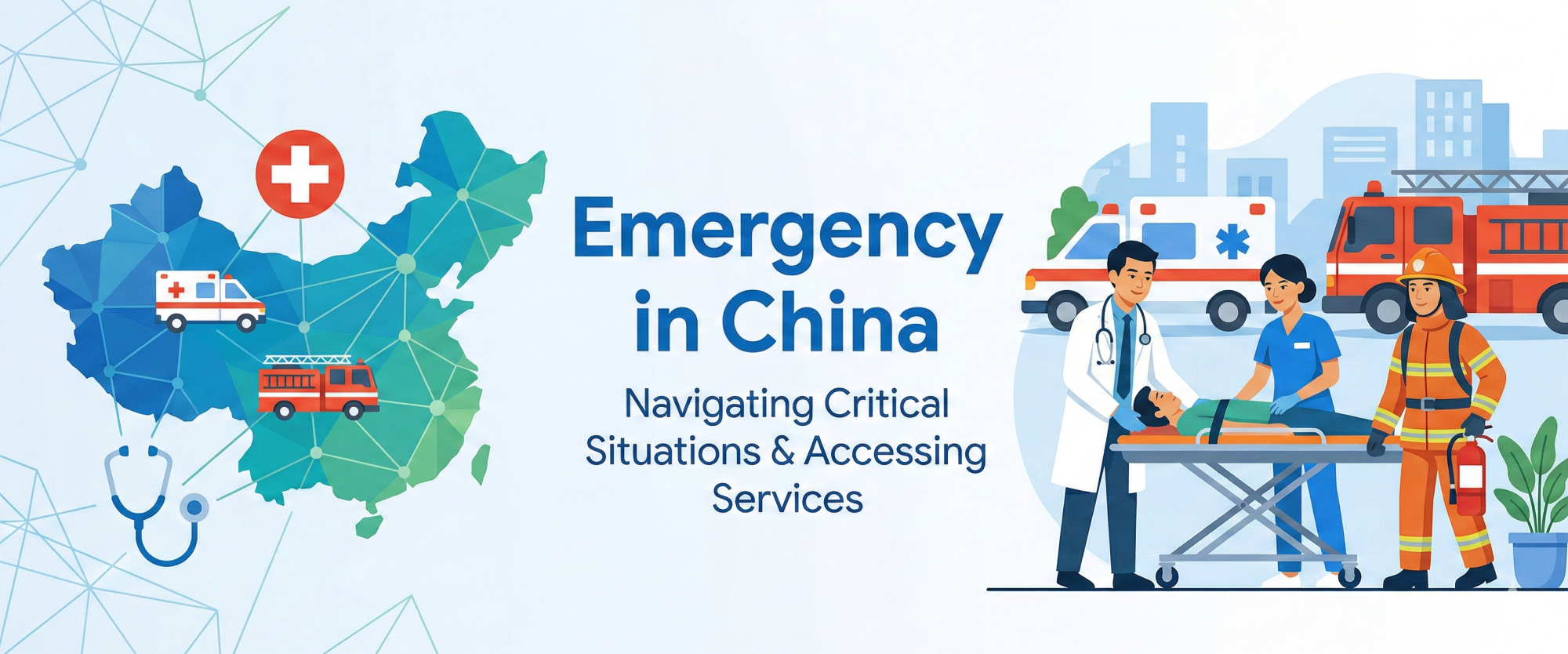
Medical emergencies are stressful anywhere. In China, what often trips up international visitors is not the hospital care itself, but the first 10 minutes: knowing which hotline to call, communicating a precise location, and understanding how ambulance transport and hospital emergency departments (EDs) typically work.
China does not use a single “911/112” number nationwide. Instead, emergency dispatch is separated by service type, with 120 as the nationwide number for medical emergencies and ambulance dispatch.
1. Emergency Numbers in China (Save These Now)
These are the standard emergency numbers commonly listed in official guidance.
| Service | Number | What it connects to | Use it when… |
|---|---|---|---|
| Ambulance / medical emergency | 120 | Emergency medical service dispatch (EMS) | Serious illness/injury, difficulty breathing, chest pain, suspected stroke, heavy bleeding |
| Police | 110 | Police emergency line | Threats to personal safety, crime, urgent police assistance |
| Fire & rescue | 119 | Fire and rescue services | Fire, smoke, gas hazards, rescue situations |
| Traffic police | 122 | Traffic accident reporting | Road accidents; call 120 as well if anyone is injured |
| Maritime SOS (coastal/water) | 12395 | Maritime search & rescue | Emergencies at sea/coastal waters |
Beijing Note: 120 vs. 999
In Beijing, you will see two different ambulance services: 120 and 999.
- 120 is the primary, government-run emergency dispatch service used nationwide.
- 999 is operated by the Beijing Red Cross Emergency Rescue Center.
What to use: For acute life-threatening emergencies, dial 120 first. While 999 still provides emergency response, it has increasingly shifted toward non-emergency medical transfers, high-altitude rescue, and international medical repatriation. In a crisis, 120 is the most integrated into the city’s public hospital network.
2. Calling 120: What to Say (and How to Handle the Language Barrier)
If you call only once in an emergency, prioritize location. Dispatch speed depends heavily on how clearly you can explain where you are and how to reach you.
What the dispatcher needs (in this order)
- Exact location: city + district + street + building name/number + nearby landmark
- What happened: accident vs sudden illness
- Key symptoms: unconscious, not breathing, severe bleeding, chest pain, one-sided weakness (possible stroke symptom), etc.
- Patient basics: approximate age/sex, known conditions if you know them
- Callback number
If you don’t speak Chinese
In major cities, you may sometimes reach English support, but it is not guaranteed. The most reliable option is often to ask a Chinese speaker nearby (hotel staff, coworker, bystander) to place the call and describe the address precisely.
3. Ambulance Arrival, Transport Decisions, and Costs
Where the ambulance will take you
Ambulance crews are generally required to transport patients to the nearest designated emergency-capable hospital to ensure timely treatment. While you can suggest a specific hospital, the crew will make the final decision based on your clinical condition and the hospital’s current capacity.
Ambulance Fees (Services are not free)
In China, ambulance services operate on a fee-for-service basis. The total cost usually ranges from 300 to 1,500 RMB, depending on the city and the complexity of the case. Your bill will typically include:
- Dispatch / Pre-hospital Care Fee: A flat starting rate for the emergency call-out.
- Mileage Fee: Charged per kilometer from the ambulance station to the scene, and then to the hospital.
- Medical Treatments & Supplies: Charges for oxygen, ECG monitoring, medication, or any emergency procedures performed in transit.
How to Pay for the Ambulance
Unlike hospital bills, the ambulance fee is usually settled separately once you arrive at the hospital or during the transfer.
- Mobile Payment (Preferred): Most ambulances are equipped with handheld scanners. You can pay via Alipay or WeChat Pay.
- Cash: Always a reliable backup. Ensure you have at least 1,000–2,000 RMB in cash if your mobile payment is not set up.
- Credit Cards: Direct swiping of international credit cards (Visa/Mastercard) is rarely supported on the ambulance itself, though they are widely accepted at the hospital’s main billing counter.
Tip for Visitors: Ensure your international Visa/Mastercard is linked to your Alipay or WeChat account before an emergency occurs. See Hospital Payment Methods in China: A 2026 Practical Guide for International Patients
4. Arriving at the ER (急诊 / Jízhěn): Two Pathways
China’s emergency departments are triage-driven. What happens next usually depends on whether your situation is considered life-threatening.
A) “Green Channel” (绿色通道): treatment first for critical cases
Many hospitals describe “Green Channel” rules for critical emergencies (severe trauma, cardiac arrest, stroke, respiratory failure, etc.), where urgent treatment is prioritized and administrative/payment steps may be handled later.
B) Standard ER Visits: The “Pay-as-you-go” Workflow
For urgent but stable conditions (e.g., high fever, minor fractures), you will follow the standard sequence:
- Registration & Triage: Pay a small registration fee and get your urgency level rated.
- Initial Assessment: See the ER doctor.
- The “Pay-First” Step: You must pay for diagnostic tests (blood work, X-ray, CT) before they are performed.
- Treatment & Pharmacy: After the diagnosis, you pay for the specific treatment or medication before receiving it.
5. If Cardiac Arrest Is Suspected: Call 120 and Use an AED if Available
If someone is unresponsive and not breathing normally:
- Call 120 immediately
- Ask someone to locate an AED
- Start CPR if trained
Public guidance in China’s major cities emphasizes calling emergency services and using AEDs when indicated.
6. A Phone-Ready “Emergency Card” (Save for Reference)
Create a note on your phone (in English, and in Chinese if possible):
EMERGENCY INFO (China)
- Full name (passport):
- Passport no.:
- Current address in China (include hotel name + address):
- City / District:
- Phone number in China:
- Emergency contact (name + phone + relationship):
- Allergies (esp. medications):
- Chronic conditions:
- Current medications:
- Blood type (if known):
- Key language needs (e.g., “English only”):
7. What to Say on the Phone (Ready-to-Use Phone Script)
English (simple and fast)
“Medical emergency.
I’m at [hotel/building/landmark], [street], [district], [city].
The patient is [unconscious / not breathing / severe chest pain / heavy bleeding / possible stroke].
My phone number is [xxxx].”
Helpful Chinese keywords (to recognize on signs / forms)
- Ambulance: 救护车
- Emergency department (ER): 急诊
- Address: 地址
- Landmark: 地标
- Chest pain: 胸痛
- Difficulty breathing: 呼吸困难
- Stroke: 中风 / 脑卒中
- Allergic: 过敏
8. FAQ: Emergencies in China
Q1. Is there a “911” in China?
Not as a single nationwide number. China uses separate emergency numbers (e.g., 120 ambulance, 110 police, 119 fire, 122 traffic accidents).
Q2. What number should I call for an ambulance?
Dial 120 nationwide. In Beijing, you may also see 999, but 120 is the national standard.
Q3. Is the ambulance free?
Typically no. Ambulance transport and associated emergency services usually involve fees; Beijing’s emergency service pricing information and related municipal policy reporting describe charged services and price disclosure.
Q4. Can I request English when I call 120?
Sometimes in major cities, but it isn’t guaranteed. If possible, ask a Chinese speaker nearby (hotel staff, colleague, bystander) to place the call to avoid delays in communicating the exact address.
Q5. Which hospital will the ambulance take me to? Can I choose?
Ambulances commonly take patients to the nearest appropriate hospital for the condition, especially when time is critical. You can request a specific hospital, but crews may prioritize speed and clinical suitability.
Q6. Will the ER treat me if I can’t complete registration or payment immediately?
For life-threatening emergencies, many hospitals describe “Green Channel” processes that prioritize urgent treatment first. For non-critical issues, you may encounter step-by-step payment before tests/medications.
Q7. I’m in a traffic accident—who do I call?
Call 122 for traffic police and 120 if there are injuries.
Q8. What should I keep for insurance reimbursement later?
Keep your official invoice (Fāpiào/发票) when available, itemized expense lists, and key medical documents (test/imaging reports, discharge summary if admitted). This makes overseas reimbursement much smoother. see Getting Your Insurance Documents Right: A Practical Guide to Fapiao and Medical Paperwork in China.