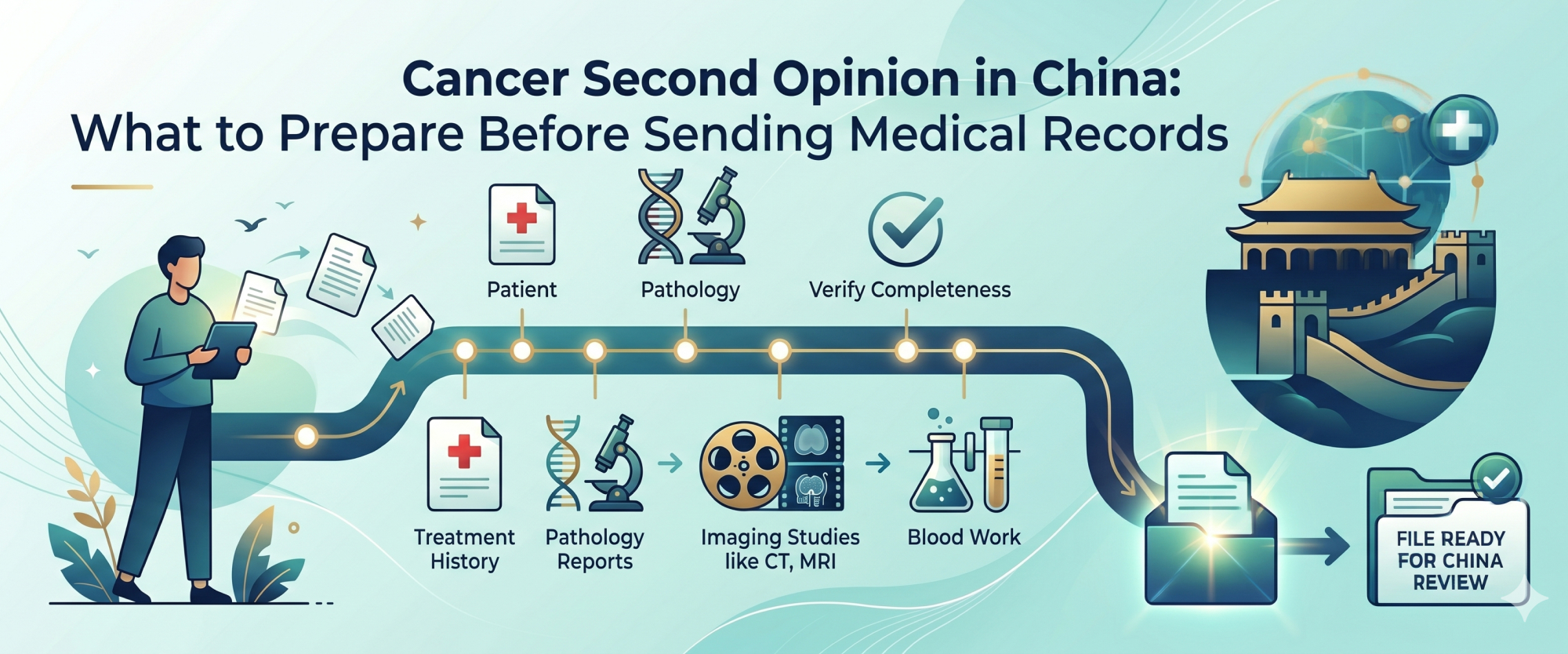

A second medical opinion in China helps when a diagnosis already exists and the next treatment step still needs review. Patients often reach this point after an orthopedic MRI, a cancer diagnosis, a surgery recommendation, a complex chronic condition, or different treatment advice from different doctors.
In China, a useful review depends heavily on records. Doctors often need Chinese or translated reports, original imaging files, pathology materials, treatment records, and a clear disease timeline. China’s medical-record rules allow patients or authorized representatives to request copies of many clinical documents, including outpatient and inpatient records, lab reports, imaging materials, surgical and anesthesia records, pathology materials, nursing records, discharge records, and medical expenses, with institutional confirmation marks on copies.
This guide explains when a second opinion may fit, how it differs from a general consultation or face-to-face visit, which documents matter most, what a doctor may clarify from records, and which questions usually require in-person evaluation or further tests.
When a Second Medical Opinion Fits in China
A second opinion usually fits when the patient already has a working diagnosis or a specific treatment question. The reviewer needs a defined medical issue: diagnosis review, imaging interpretation, pathology confirmation, treatment comparison, or next-step planning. A focused question gives the doctor a better starting point.
Common situations include:
- A doctor has recommended surgery, chemotherapy, radiotherapy, targeted therapy, immunotherapy, interventional treatment, or long-term medication.
- Imaging shows a finding, but the patient wants another specialist to review the report and original images.
- Pathology, genetic testing, or lab results carry major treatment implications.
- Symptoms continue after treatment, and the patient wants a fresh view of the case history.
- A family needs to compare treatment options before arranging travel, admission, or further specialist visits.
China’s medical system also uses formal clinical mechanisms for complex cases, including consultation systems and difficult-case discussion systems inside medical institutions. The National Health Commission lists consultation, difficult-case discussion, preoperative discussion, medical-record management, and other systems among core medical quality and safety systems.
If your question begins with an abnormal screening report rather than an existing diagnosis, see [Health Check-up Results in China: Reading Your Report and Using It].
Second Opinion, Case Review, Consultation, and Face-to-face Visit
Readers often use “second opinion” to describe several different activities. In China, these activities can lead to different levels of medical judgment.
| Term | What it usually means | What to prepare |
|---|---|---|
| General consultation | A broad discussion about symptoms or next steps | Symptoms, past history, recent reports |
| Medical record review | A doctor reviews existing reports and files | Diagnosis, imaging, pathology, treatment records |
| Second opinion | A specialist gives another view on diagnosis, treatment options, or next steps | Complete record set and focused questions |
| Face-to-face specialist visit | The doctor examines the patient and may order further tests | Passport or ID, records, imaging files, current medicines |
| In-hospital consultation | Doctors discuss a case through the medical institution’s system | Hospital-managed clinical file |
Remote and internet-based medical services in China follow regulated categories. NHC policy materials describe telemedicine between medical institutions, internet diagnosis for some common and chronic disease follow-up, and internet hospitals; they also describe situations where a doctor at a physical medical institution invites another doctor for consultation through an internet hospital.
A record-based second opinion clarifies the review direction. A face-to-face visit gives the doctor examination findings, current symptoms, and new test results.
Medical Records That Make a Case Reviewable
A case review starts with documents. The file sets the medical facts a doctor can review. China’s medical-record rules define many materials that patients may copy or access, and the Medical Records Writing Basic Standards describe outpatient and inpatient records as including history, examination findings, auxiliary test results, diagnosis, and treatment opinions.
| Record type | Why it matters |
|---|---|
| Diagnosis report | Shows the current working diagnosis and clinical basis |
| Imaging report | Gives the radiologist’s interpretation of MRI, CT, X-ray, ultrasound, or PET-CT |
| Original imaging files | Let the specialist review the images directly, often through DICOM files |
| Pathology report | Confirms tissue-based findings in cancer, tumors, inflammatory disease, and some surgical cases |
| Pathology slides or blocks | May support pathology review when the case requires it |
| Lab results | Show blood counts, liver and kidney function, tumor markers, inflammation markers, hormones, or other disease-specific data |
| Operation record | Explains what surgeons found and did during a procedure |
| Discharge summary | Connects diagnosis, treatment, complications, medicines, and follow-up advice |
| Treatment history | Shows past surgery, medication, chemotherapy, radiotherapy, rehabilitation, or procedures |
| Medication list | Helps the doctor understand current therapy, drug interactions, and treatment tolerance |
Use the Chinese term below when asking for medical-record copies:
病历复印件(bìnglì fùyìnjiàn)
medical record copies
For a closer look at record types, imaging files, stamped copies, and document formats, see [Medical Records & Imaging in China: A Guide for International Patients].
Building a Disease Timeline and Question List
A second opinion works best when the reviewer can see the case in order. A timeline helps the doctor understand which event came first, how symptoms changed, and how each test or treatment affected the next decision.
A practical timeline can use this format:
| Date | Event | Result or change |
|---|---|---|
| March 2025 | Knee pain started after running | Pain on stairs and squatting |
| May 2025 | MRI completed | Meniscus tear reported |
| June 2025 | Medication and physiotherapy | Partial symptom relief |
| August 2025 | Doctor suggested surgery | Patient wants another specialist view before deciding |
For cancer or complex disease, add diagnosis date, pathology date, staging tests, surgery, systemic treatment cycles, radiotherapy schedule, adverse reactions, genetic testing, and the latest disease status.
The question list matters as much as the documents. Strong questions sound specific:
- Does the record support the current diagnosis?
- Do the imaging findings match the symptoms?
- What treatment options usually need discussion for this stage or condition?
- Which missing tests would change the treatment decision?
- Does the case need a face-to-face specialist visit before treatment planning?
- Which documents should the patient collect before traveling?
A family member can prepare this timeline, but the patient’s symptoms, current medicines, allergies, and treatment tolerance need direct confirmation.
What Records Let a Doctor Clarify
A complete file helps the doctor check whether the current diagnosis, test results, and treatment recommendation fit together. The reviewer can also identify record gaps that affect the next step.
A record-based review may help answer questions such as:
- Whether the diagnosis report and imaging report point in the same direction.
- Whether original imaging files need a specialist or radiology review.
- Whether pathology, genetic testing, or staging information looks sufficient for treatment discussion.
- Whether a treatment recommendation matches the documented diagnosis and disease stage.
- Whether the next step looks closer to recheck, specialist visit, pathology review, imaging review, or inpatient evaluation.
- Whether the patient can prepare further materials before traveling to China.
For complex inpatient, surgical, or pathology-related records, see [Medical Records & Imaging in China: A Guide for International Patients].
Questions That Require Face-to-face Evaluation
Some questions need direct examination, new tests, or hospital-level assessment. China’s Medical Institutions Regulation states that a medical institution may issue disease diagnosis certificates, health certificates, or death certificates only after a physician personally examines the patient.
Face-to-face evaluation often matters for:
- New or worsening symptoms.
- Severe pain, weakness, bleeding, fever, weight loss, breathing difficulty, or neurological signs.
- Surgery planning.
- Anesthesia risk assessment.
- Prescription changes for high-risk medicines.
- Treatment that requires admission, procedure rooms, infusion units, radiotherapy planning, or rehabilitation assessment.
- Cases where the available records conflict with the current condition.
A second opinion helps the patient prepare for the visit. The doctor’s clinical evaluation and the medical institution’s process determine the formal diagnosis, treatment plan, prescription, admission decision, procedure plan, and medical certificate.
For appointment flow, registration, payment, and department selection during an in-person visit, see [How to See a Doctor in China: A Step-by-Step Guide for Foreigners].
Checking Whether Your File Is Ready
Before sending records for review, run a short readiness check. A clear file reduces repeated document requests and helps the reviewer focus on the medical question.
| Readiness question | What a useful file contains |
|---|---|
| What diagnosis has the patient received? | Diagnosis report, clinic note, discharge summary |
| What evidence supports it? | Imaging report, original imaging files, pathology, labs |
| What treatment has already happened? | Operation records, medication history, therapy records |
| What decision needs review now? | Surgery, medication, cancer treatment, rehabilitation, further testing |
| What changed recently? | Recent symptoms, new results, treatment respons |
| What does the patient want answered? | Three to five focused questions |
Also check practical details:
- Match the patient’s name, passport number or ID, date of birth, and report dates across documents.
- Keep original language reports and any English translations together.
- Ask the prior facility how to export imaging files.
- Confirm whether stamped copies or electronic files support later insurance, overseas follow-up, or another medical visit.
- Keep a medication list with generic names, doses, frequency, and start dates.
If the file comes from a recent check-up, see [Health Check-up Results in China: Reading Your Report and Using It] before deciding which finding needs specialist review.
GET IN TOUCH
Get a Remote Second Opinion Before Your Next Medical Decision
- Get a records-based written or video Remote Second Opinion from specialists in China.
- Better understand your existing diagnosis, test results, and treatment recommendation.
- Clarify whether to continue local care, prepare additional records, or seek further specialist evaluation.
- If in-person evaluation is recommended, explore possible care coordination options in China.
- If you already have pathology, imaging, gene testing, or treatment records, a structured file can make the first review more focused. Prepare the key records, current-condition summary, and timeline before asking a doctor to assess the case.
FAQ
Q1. Can I seek a second medical opinion in China before treatment?
Yes. Many patients seek another specialist view before surgery, cancer treatment, long-term medication, or complex rehabilitation. A useful request includes an existing diagnosis, key test results, current symptoms, and a clear question. A doctor can review the records and suggest what the next evaluation should cover. Clinical evaluation still drives the formal diagnosis and treatment plan.
Q2. What medical records do I need for a second opinion in China?
Prepare diagnosis reports, outpatient or inpatient records, lab results, imaging reports, original imaging files, pathology reports, treatment records, operation records, discharge summaries, and a current medication list. For cancer, pathology and staging materials matter. For orthopedics, original MRI, CT, or X-ray files matter. For chronic disease, past medication response and recent lab trends matter.
Q3. What imaging materials help a doctor review my case?
An imaging report helps the reviewer understand the radiologist’s interpretation. Original imaging files let another specialist examine the scan directly. For MRI, CT, and X-ray, ask the facility for DICOM files when available. Bring the written report and the image files together.
Q4. Can a second opinion replace an in-person specialist visit?
A second opinion gives another medical view based on available records. A face-to-face visit adds physical examination, current symptom assessment, and further testing when needed. Surgery planning, new prescriptions, admission decisions, and medical certificates usually require direct evaluation through a medical institution. Record review works best as preparation for the next medical step.
Q5. How should I organize my disease timeline?
Start with the first symptom, first diagnosis, major tests, treatment dates, medication changes, surgery, hospital stays, and recent changes. Use exact dates when available. Add a short note on symptom changes after each treatment. Keep the timeline to one or two pages so the reviewer can read it quickly.
Q6. Can family members prepare the second opinion file?
Yes. Family members often organize records, translations, imaging files, and questions. The file should still reflect the patient’s actual symptoms, current medicines, allergies, and treatment preferences. For record copying or access, Chinese rules may require identity documents and authorization when someone acts on behalf of the patient.
Q7. What if my case file still has gaps?
List the record gaps clearly and share the documents already available. A doctor can identify which gaps matter most for the review. Gaps in pathology, original imaging, staging tests, operation records, or medication history may shape how far the reviewer can go. The next step may involve requesting copies from the previous facility or arranging a face-to-face specialist visit.stamped documents. If the recommendation points to a specialist visit or prompt review, ask which department handles the finding and whether an appointment can fit before departure.